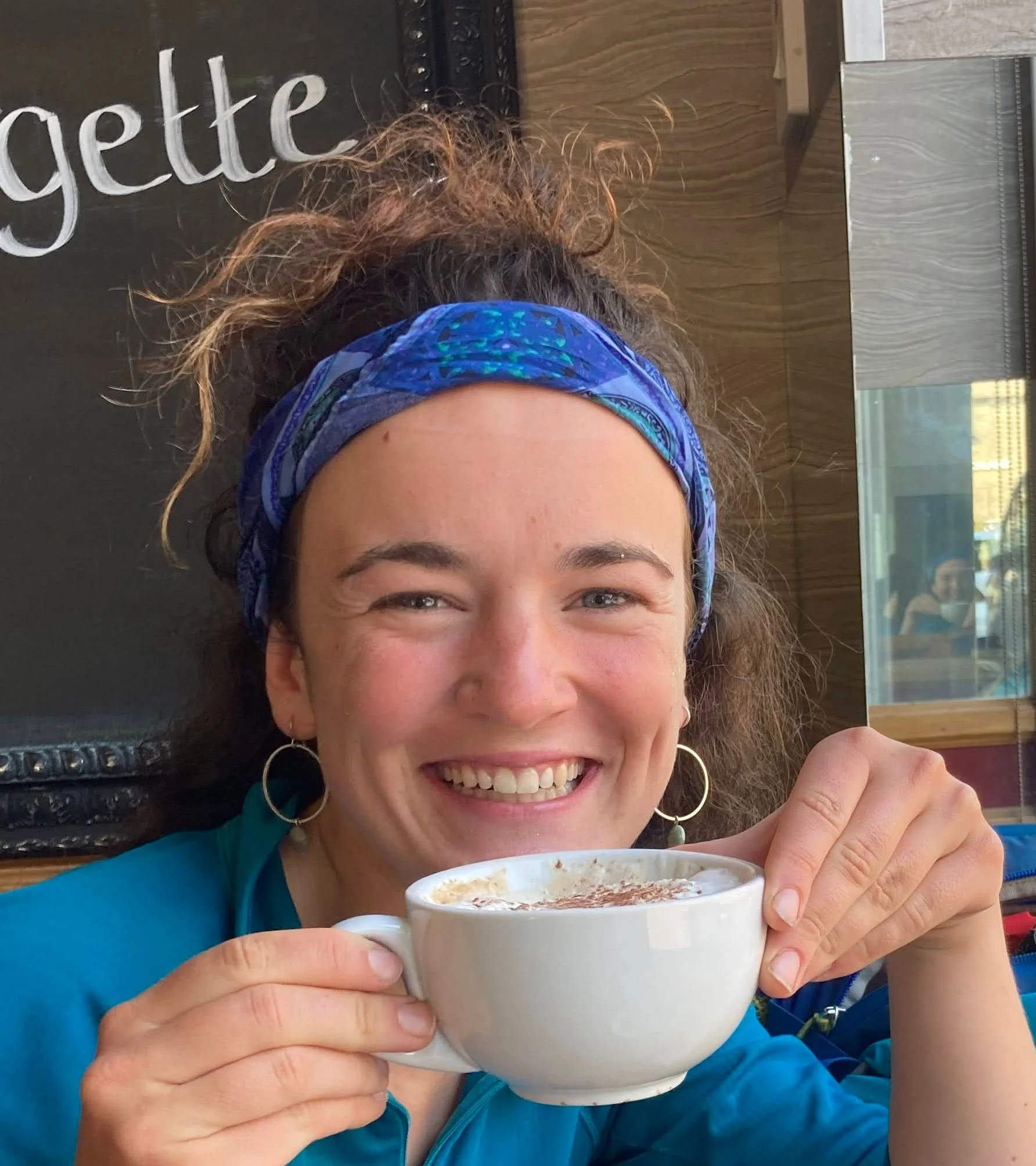
Ardyn Ford on the natural world, the uncanny, and the impossible. <em> Ardyn Ford in conversation with Sara Byrnes</em>
Read “washed in red light,” here.
Sara
You render the natural world so beautifully in this essay—capturing not only the beauty, but also the violence and indifference of it. I’m thinking now of the line, “Both of us had spent more time in the woods than in the city in our adult lives.” Have these violent or indifferent experiences changed how you view the world? Are there any spaces you consider significantly impactful to your worldview and writing perspective?
Ardyn
Totally! Growing up in Salt Lake City, where many people treat the surrounding landscape as a giant playground, I internalized this idea that the outdoors should always bring me joy and peace. In this way, violent and indifferent encounters in the natural world have challenged my relationship with control.
Environmental historian Richard White writes, “Work once bore the burden of connecting us with nature. In shifting much of this burden onto the various forms of play that take us back into nature, Americans have shifted the burden to leisure. And play cannot bear the weight. Work entails an embodiment, an interaction with the world, that is far more intense than play. We work to live. We cannot stop. But play, which can be as sensuous as work, does not so fully submerge us in the world.”
For me, working seasonally forced a reconsideration of the nature of nature. Over time, the pressure I put on the natural world to be a bastion of delight made it increasingly difficult for me to actually enjoy time spent outside. Work bled into play, and I could no longer escape the darkness that courses through both myself and the world around me. It felt like a rough exit from the honeymoon phase of a relationship. Writing has helped me learn to embrace both the dark and the light.
Sara
I love depth psychology, but the guy I’m fascinated by is Carl Jung. I personally think he honors the sacredness of these “uncanny,” “mysterious,” almost religious experiences more. Plus, I find the idea of archetypes almost possessing, and Jung’s exploration with them dovetails nicely with my own work as a writer. How did you discover Freud? What impact has his lens on psychology had on your work? On your life?
Ardyn
I’m also a fan of Jung! His work on the concept of synchronicity, which feels connected to the uncanny, has really allowed me to make connections between disparate events in my life in a way that feels meaningful and empowering. Freud, conversely, is a figure I tend to approach, for a number of reasons, with more skepticism. One of those reasons being his dismissiveness of all that is mystical.
I became interested in psychology as a child, after my dad was diagnosed with schizophrenia, which, from my perspective, is a disorder that is deeply entangled with the uncanny. During my own experiences in therapy as a young adult, I discovered Jung and Freud.
I’m most compelled by Freud’s conception of the unconscious and its relationship to meaning-making. Paying attention to the ways in which I experience the present moment through the filters of my past is humbling and, as a practice, has helped me learn to tell new stories about myself and my life.
Sara
There’s something to be said about the different ways different gender expressions experience the natural world. One of the threads of “washed in red light” comments on this idea through scene work. Did your experience in Scotland change how you view the natural world? How you view yourself in relation to it? How your gender expression perhaps limits the true freedom you can experience there?
Ardyn
Beyond the encounter with the man at Bonar Bridge, biking through Scotland absolutely challenged my view of the natural world, particularly because of how entangled the constructed and natural environments are there. Many of the old, stone buildings and fences are so covered in moss and greenery it looks like they are being swallowed by the Earth. Prior to this trip, my perception of “wilderness” was very tied up in the vast expanses of public lands that define the Western US. In Scotland, even in the most remote sections of our trip, we never went a day without passing through a town, and this really contradicted my fantasy of nature as a pristine or separate space.
All this is to say that even in natural environments, we are still subject to cultural realities, which is something my friends and I confronted when the man approached our tent. The experience made us feel so vulnerable, and sleeping in a tent became much more frightening after that. We kept joking that we needed a recording of a deep, masculine-sounding voice on our phones to play in the event of another intruder.
Sara
I’m absolutely fascinated by the idea of the impossible, by what it asks of the receiver of the experience. The concept of aliens used to feel more impossible to me than it does now. The idea that a deer would choke on a bra also feels impossible, but in a more believable way than aliens. Have you seen anything else “impossible” in your experiences in the natural world that challenged long-held beliefs?
Ardyn
Yes! A few years ago, I was working as a guide on the Salmon River in Idaho, and we launched on a six-day trip through the Frank Church Wilderness in the midst of a wildfire. Our guests on this trip were the top performers at an Idaho Falls–based pyramid scheme called 7K Metals, which specializes in the sale of collectible silver and gold coins. They also happened to be conspiracy theorists.
Somehow, I found myself floating down a river full of flaming trees and ash, literally watching the world burn around me while listening to some of the most bizarre conversations of my life. The people on my raft surmised that the wildfire had been started by a drone strike, sent by the Biden administration to incite a class war. This devolved into a lengthy conversation about the evils of women’s liberation, and then I found out that one man had stormed the Capitol on January 6th. And we were all stuck together in the largest wilderness area in the lower 48 for a week!
It felt like a truly incomprehensible situation to be in. And as a receiver of this experience, I felt I had no choice but to try and stay open to what I was witnessing. It was easy for my coworkers and me to lean into a sense of moral superiority over these guests, but I couldn’t help but wonder: What would it be like to believe them? In the burning wilderness, the boundaries of reality began to feel quite malleable.
Sara
Do you believe in aliens? (lol)
Ardyn
Yes! Maybe not of the UFO variety, but I definitely believe in life beyond Earth.
Sara
You’re clearly well-traveled. And you clearly love the natural world and what it has to offer. Is there one place you’ve visited and explored that sticks out for you among the rest as somewhere you would recommend everyone try to go?
Ardyn
The southwest! In particular, Grand Staircase-Escalante National Monument, which the Trump Administration continues to threaten, is a place that has played a formative role in my life. The desert has so much to teach us about survival and beauty and extremes. There is nothing quite like being in the depths of a slot canyon, shivering in the near dark on a cloudless, one-hundred-degree day in the desert.
It is so otherworldly, and there is so much fantastic writing coming out of the southwest to deepen one’s experience of visiting. A recent favorite of mine is Zak Podmore’s Life After Deadpool, which details the revival of Glen Canyon in the face of a sinking Lake Powell. It’s hopeful and funny and incredibly well-researched—I can’t recommend it enough!
Sara
In this essay, you talk of work you did pulling invasive weeds and how it often felt like a “fruitless task.” Did you learn anything from this? Was there a kernel of truth you walked away with? I also want to ask, did you ever figure out “What would save [you] if not the birds and the wind and the trees?”
Ardyn
My biggest takeaway from my weeds crew summer was that I was not cut out for that type of work, haha.
But actually, I went into that job thinking it would be this Zen experience, where I hiked and pulled weeds peacefully all day, giving back to the mountain range that raised me. Instead, it was intensely confronting. In the quiet drag of each day, I had to face the realities of our irrevocable and ever-growing impact on the natural world and also, the noisy mess of my mind. The discomfort I felt was a reminder of how heavily I rely on distraction and stimulation and fantasy to get through life. Amidst the weeds, it was difficult to pretend.
On days when I was in a more positive mental state, I could find the beauty in conducting a “fruitless” task rooted in care. And the impact we had, though small, made me suspect that if more people had the time and energy, we could actually do a lot to ameliorate issues like invasive species.
I think I’m still learning the answer to your final question. It seems selfish to hang our salvation on the natural world. Perhaps through solidarity with the birds and the wind and the trees, we have a better shot at saving each other, even briefly.