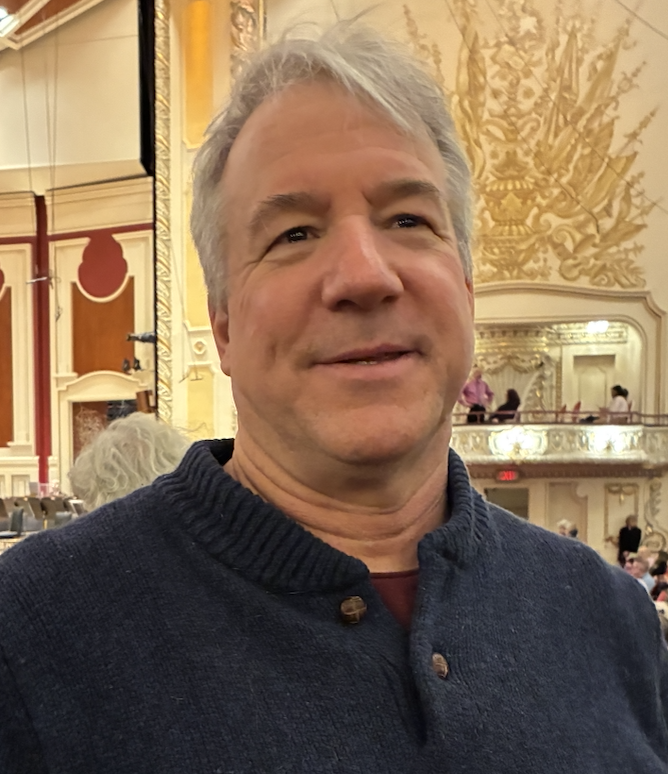
Mark Brazaitis on the art of fiction and writing what you know. <em>Mark Brazaitis in conversation with editor Sara Byrnes </em>
Read “A Voice in the Woods” here.
Sara Byrnes
Where did this story begin for you? Was it a character, an image, a setting, a theme, or something else entirely?
Mark Brazaitis
In 2017, I ran for a position on the Morgantown, West Virginia, City Council. One of my goals was to encourage the city to buy a 42-acre forest at its western edge and incorporate it into its underwhelming park system. I knew the Haymaker Forest, as it was called, well; my backyard abutted a portion of it (as did a hundred other backyards).
After I was elected, I was thrilled when the forest’s owner said he was open to a sale. The price was high—$5.2 million—but I thought it was worth it. A forest isn’t a car you hope will last a decade. It’s an eternal investment. To encourage public support for the forest, I led a dozen tours of it, open to anyone. I spoke on local radio, including on the show of a pair of hostile right-wing opponents of the purchase. I wrote op-eds in the local paper. The appraisal of the forest the city commissioned came back a disappointing $2.5 million. Laws prevented the city from offering the forest’s owner anything more. Destruction of the Haymaker Forest—trees knocked down, townhouses erected—commenced soon thereafter.
Half of the forest remains intact, but what was lost haunts me. That loss inspired this story.
Sara
I’m fascinated by multiplicity, by the subjective nature of reality, by the idea that things can be “both and” instead of simply “either or,” and the idea that there is more than one truth. I would argue that this story exists in this same space. I thought choosing to have Adam be the main perspective we exist in throughout this story really allowed us to see this layered truth concept fleshed out. It seemed to me that this perspective invites readers to wrestle with competing truths rather than settling comfortably into one interpretation. Was the perspective on this story intentional? Was there a core human truth you hoped to reveal in using this perspective?
Mark
I wanted to challenge readers’ understanding of reality in the story. Is Adam hallucinating his encounters with Sylvia? Or is she a magical being who befriends Adam because he shares her reverence for the woods? Even if Adam is hallucinating, is he wrong to think Sylvia exists? Is she representative of the intangible but real spirit of the forest, a singular being who embodies the collective?
If there’s a core human truth in the story, it might be our desire to be understood and appreciated on our own terms, something Adam finds with Sylvia and is denied in most of his other relationships.
Sara
Is the location of the forest that Adam visits throughout this story inspired by a real place?
Mark
Yes. See above! (The forest’s size in “A Voice in the Woods” is a nostalgic nod to Winnie-the- Pooh’s Hundred Acre Wood.)
Sara
The age of Adam felt important to this story. So much of our lives is out of our control when we are teenagers just on the verge of adulthood, and Adam’s sovereignty is further complicated by his experiences of mental illness. Why did it feel important for this story to occur at that particular stage of life rather than later in adulthood? What possibilities did adolescence open up for the story that another period of life would not have?
Mark
To be a teenager is (in my experience!) to be lonely and to long for love, laughter, acceptance, and communion. What the human world doesn’t offer Adam, the world of the woods does.
Also: Adam is close enough to childhood not to have dismissed the possibility of miracles and magic from his life.
And: mental illness can be extraordinarily burdensome and even dangerous, as I know well. On the other hand, it can offer up perspectives unavailable to people with a stable psychological makeup. Our suffering can make us more attuned to suffering experienced by others, including nonhuman animals and, yes, entire ecosystems.
Sara
One aspect of the story that stayed with me was the way Adam’s visions occupy an uncertain space between illness, imagination, and insight. As children, we’re often encouraged to inhabit imaginative worlds, but as we age we’re expected to distinguish more sharply between imagination and reality. Reading the story made me think about how creative work can allow adults to remain in contact with those imaginative realms. Was that tension between imagination and reality something you were consciously exploring while writing Adam, and how do you see his visions functioning within the story?
Mark
Yes. Absolutely. The story does explore the tension between imagination and reality. And it asks whether Adam’s “imagined” relationship with Sylvia isn’t a better way of engaging with the forest than to treat it as a mere commodity and hindrance to “progress.”
There’s a reason forests are both so often the settings of fairy tales and places frequently central to our childhoods. They are potent with possibilities that non-arboreal worlds just don’t offer.
Sara
One angle I enjoyed in this story was the connection between Adam and the natural world. In my reading, I found myself drawing a connection between those who accept the scientific consensus regarding climate change and those who do not. The story could’ve easily shifted into black and white, where everyone who believes the Earth is dying is institutionalized, and those who don’t aren’t—but “A Voice in the Woods” doesn’t do that. The story exists in the gray space between these concepts. We get this clarity when Adam is admitted to the hospital and meets the rest of the people there—and admittedly that’s just one read of the story. The story seems to invite multiple, sometimes contradictory readings. Was that openness something you consciously pursued while writing it? What inspired you to take this angle?
Mark
I believe in the science of climate change. I’m a member of two environmental organizations in Morgantown—the Morgantown Green Team and the Mon Valley Green Space Coalition—and we encourage the acquisition, recreational use, and preservation of green spaces. Our big ongoing effort is to create a Morgantown Greenbelt, a connected trail system that would allow people to navigate around the city on foot or bike. The benefits (even economic!) would be huge.
As a fiction writer, however, I want to reflect the complexities and contradictions of our world, including the way people think about and engage with (or don’t engage with) natural environments. When I’m writing short stories, I remind myself not to be didactic. I am, however, a fan of two prominent works that encourage creative writers to be agents of good: Leo Tolstoy’s What is Art? and John Gardner’s On Moral Fiction.
Sara
I enjoyed the symbolism that occurs when Adam cries out for the forest, insisting it’s dying, and we as the reader know this to be true, and the police officer, representing structure, order, and the rules of society, claims the opposite is true, the forest isn’t dying, there’s nothing wrong, in fact, it’s Adam who sees something that isn’t there. This moment really landed for me. In your writing process, do you concern yourself with symbolism and imagery, or do you find that the images and scenes descend upon you and the symbolism is revealed later once the story is complete?
Mark
Sometimes an image is what inspires me to begin writing a story. When I was a Peace Corps volunteer in Guatemala, new to my small town, my young neighbors came by to introduce themselves. They also introduced me to their five-year-old brother, who they said was “born dead.” I used this startling statement as the opening to the first story in my collection The River of Lost Voices. I didn’t realize until several drafts into my story, however, that I was examining the symbolic resonance of what it would mean to have been “born dead.”
In “A Voice in the Woods,” I suppose one could say there’s symbolism even in Adam’s name. His beloved woods are a Garden of Eden.
Sara
I’d like to ask you more broadly about the act of writing. You are quite a prolific writer, having published nine books. What inspires you to keep writing? What rituals or practices do you employ to keep the momentum going?
Mark
I swim every day, and swimming has become an addiction. If I go even a day without swimming, my body craves the water. When I travel, I sometimes go way, way out of my way to find a swimming pool or a lake or an ocean. My quests can be ridiculous. I write every day, and writing, too, has become an addiction. If I go a day without writing, a part of me—my imagination, perhaps—feels it hasn’t been exercised, and I crave a blank screen or a rough draft of one of my stories, poems, or essays to work on.
My job requires me to write, and I’m grateful. In other jobs I’ve had, I’ve stolen hours here and there during the workday to write.
My experience in the Peace Corps was instrumental in my writing life. It introduced me to worlds and people and languages I never would have gotten to know otherwise; and, because I lived in a small town and (like everyone in town) lacked a telephone and TV, I had, after dark, nothing to do but read and write.
Sara
How much of a role does the natural world play in your writing process? Or more broadly, your creative process?
Mark
Living in “wild and wonderful” West Virginia for the past twenty-five years, I’ve found the natural world inescapable. Thankfully! The natural world inevitably contributes to my creative process. One of my short stories is about a man who falls in love with a tree. Pure autobiography? Maybe!
Sara
What do you think we lose when we fall out of touch with the natural world?
Mark
I’m not at all surprised that some contemporary therapeutic practices involve the natural world. (Forest bathing!) We’re healthier, I think, when we commune with the woods.