Avimancy
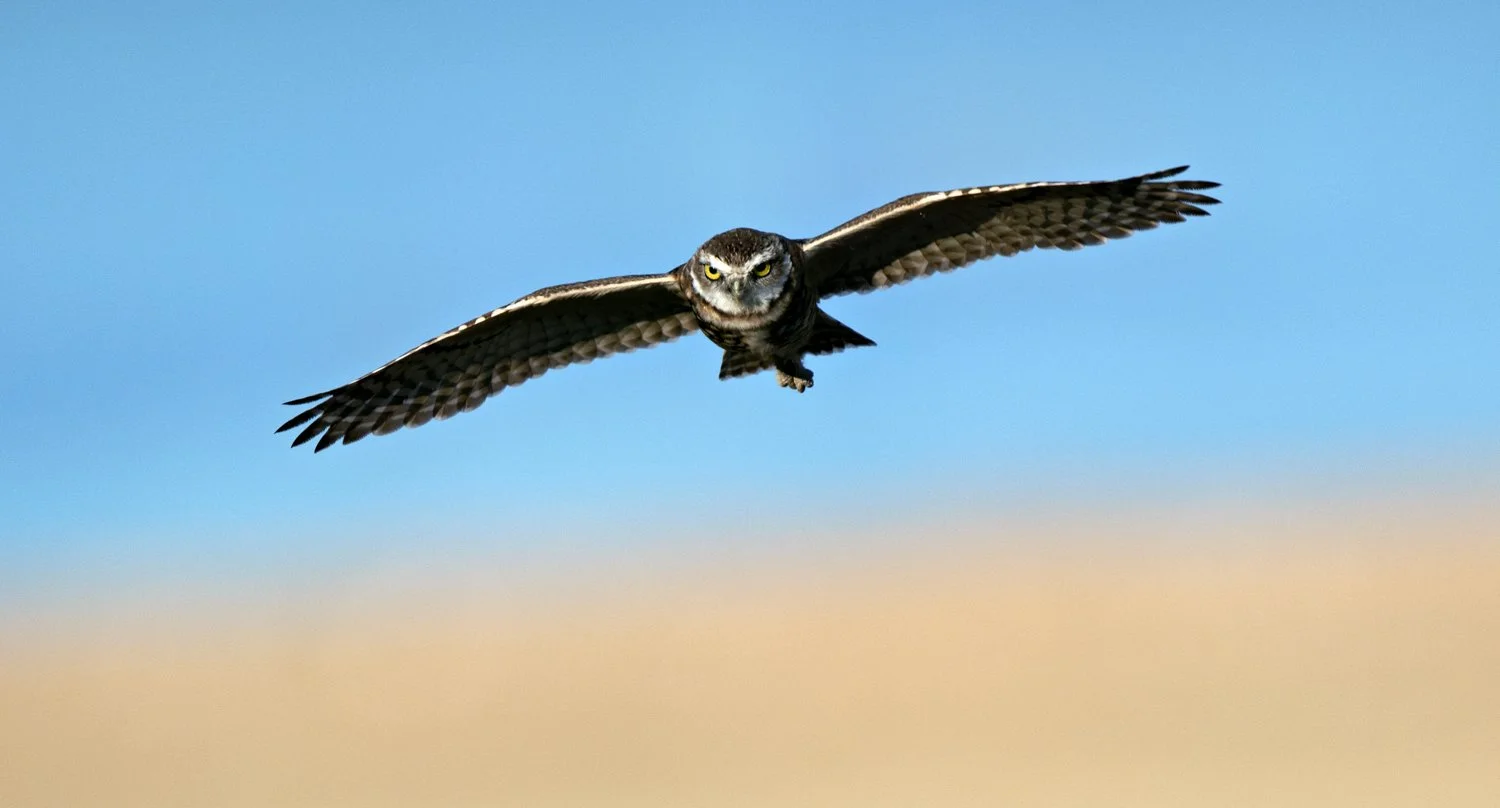
Photo by Mike Liechty
It’s not size but surge that tells us
When we’re in touch with something real.
—Mary Oliver
We enter the parking lot at a time when I would normally be considering bed. The summer sun is just setting behind the Oquirrh Mountains, taking color with it. Nearby, aspen flutter in the falling light.
“Do you think it’ll be too windy to see the owls?” I ask Michael. Trees bend on the mountains before me, and I’m thinking about how the winds on the Salt Creek Marsh near Logan keep the burrowing owls in their holes. But Michael is confident it won’t be a problem.
“It’s a perfect evening,” my husband reassures. We step from the car and make our way to a white van stickered with birds. A large man dressed in shorts and wearing a walking boot on one foot hops from the driver’s seat, all ease and openness.
“Are you Michael and Jennifer?”
Tim Avery has seen the most birds of anyone in the state—or at least he was the Utah Big Year record holder in 2007 with 355 birds and then again in 2016 with 358, almost a new bird for every day of the year. His life list includes 1,513 species from around the world, an impressive number in many ways, until you learn that scientists believe there are 18,000 species of birds on the planet. Still, the average American can only identify twenty, so 1,500 marks Tim as the birder that he is. One of the first things Tim tells us in the van as we drive up East Canyon is that in North America the first 700 sightings are easy. “After that,” he says, “it’s a grind.” The owner of Pitta Tours (motto: We. Find. Birds.), Tim knows the grind well. What I don’t fully realize but learn within minutes of the van door closing is that numbers matter to birders.
While Tim takes small groups to see birds around the Intermountain West, on this night we are in search of the flammulated owl, a species of tiny owl largely found in the mountains above Salt Lake. Like the vast majority of owls, flammys are nocturnal. They feed on moths and prefer to nest in vacated cavities of northern flickers, making this particular stretch of canyon above Salt Lake City an ideal location for seeing one: ten thousand feet, plus moths, plus the aspen and pines beloved of flickers. Aside from Tim, there are five of us in the van: Michael and I, a young woman named Ally who was raised in a family with a bird book by every window, and a couple from Pittsburgh.
“Pittsburgh!” I exclaim. “That’s quite a distance. What brings you to Utah?”
“The flammy. It’s the last owl we need.”
As an individual who bought her first pair of good binoculars a year ago and still has trouble telling a hawk from a vulture on the wing, this is the moment that I understand I am out of my league.
“But there’s like two hundred species of owls,” I respond.
“In North America,” the man corrects, and I hear judgment in his voice, “there are only nineteen.”
For my birthday, Michael bought tickets to this tour to see a flammy. We drove just ninety miles and won’t even be staying the night. These people have flown most of the way across the country to see the same owl. I feel the pressure build in the van. What if we don’t see one of these little cell-phone sized birds with bright orange flames on its back?
*
She wears a red dress, one sewn by her grandmother; yellow piping runs the edges of the Peter Pan collar and the martingale belt at her waist. Kneeling in a field of dandelions with her younger brother standing beside her in a matching red jumpsuit, Mel holds a bouquet of dandelions in her small hands. She is five. Or maybe six. And her mother has drawn the hair away from her forehead with barrettes that grab and pull. Their dachshund—no, their mother’s dachshund—named Fritz draws close to Mel. His red fur shines in the sun in a way that the dandelions do not, in a way that Mel cannot. In all three photos of the same moment, Mel never looks up. Her head is bent, and her hand never leaves Fritz’s back. She cannot lose this one. She and her brother have been sent to the field behind their home in northern Utah to collect flowers for the funeral of Amber, their mother’s other dachshund, the one Mel was told to watch the day before while they picked raspberries, the one who ran into the road and was killed.
“Why weren’t you watching?” her mother yelled, after the wailing and the keening and the slamming of pans. “This is all your fault.” Murderer is what Mel hears that afternoon, Amber’s bloody body still warm. She begins the alchemical process of making herself invisible, letting the blame dissolve her edges, becoming whisper-quiet. The day following the crime, she is dressed as if for church and sent to gather flowers while making sure the second dog remains alive.
What is her mother taking a picture of? Condemnation? Penance? Final judgement? Or does she grab the camera and walk across that field in May, grasses poking the soft arch of her sandaled foot, dust between her toes, in order to take a picture of her two sweet children, dressed to match, gathering flowers for, say, their mother, hoping to surprise her with fistfuls of the sun?
Mel knows. And she knows not because the photo recalls her to the girl she was but because that little girl remains. Decades away from the field full of dandelions, she need only run her hand along the back of her calf to feel the scar left by the yardstick wielded by her mother. The body knows. While the photo documents the moment Mel understood herself to be unworthy—a place where the narrative of trauma begins—her cells knew the story from the womb, soaked in waters that seethed disappointment and regret, attuned to her mother’s sobs, a woman born to fortune and then taken to the dirt farms of southern Idaho. If you wanted the palace and received a house with a stone for a backstep, then who is to blame? If God rains hellfire and damnation, you dare not raise your fist to the sky. Instead, punch down.
Such a common story. This one begins behind the pine curtain of East Texas. Mel’s mother, the cheerleader who could have had anyone, says the quarterback Julian Taylor, somehow falls for the Idahoan dressed in his army uniform about to ship off to war. Maybe it is his eyes that match the long Texas sky above them or maybe it is the way his uniform traces the trim body shaped strong by potato fields, but Mel’s mother meets him one afternoon at the movies and then finds herself months later, married, pregnant, and living on a military base in Louisiana. Does the dream of land and wealth and a two-story house die then? Or does it only crumble when the young couple arrives at the farm in Idaho after the war and she cannot get the soles of her feet clean ever again? By then she has converted to Mormonism—swapped Southern Baptist guilt for the death grip of Mormon perfection—but she will never be accepted by those who are truly righteous, those whose ancestors pulled handcarts across the prairies and through the Jurassic limestone of Emigration Canyon. At family dinners, when she wants the salt, she must ask her husband to make the request for her. The rest of his family does not see her. She eats her food unsalted.
Invisibility passes down like a recipe.
After the field and the flowers and the funeral—the dog buried in soil that was frozen just two months before—Mel understands that she is unforgiven. Her mother need not say this out loud. At five, Mel can read silence. She makes few friends, asks fewer questions. To an outsider, she appears awkward, clumsy, and shy. Trauma leaves no marks that can be read by ordinary eyes. Raised by a mother who whittles switches from regret, Mel learns to hide.
*
The first place we stop to try and see a flammy is an outlook where you can access the Great Western Trail, the trail walked by the Mormon pioneers in the 1800s as they fled Illinois for a place that allowed them to live free from federal intervention. I step onto the path conflicted. I know that many who walked this same earth had walked for thousands of miles, carrying their only possessions in handcarts, and when they saw the valley below they must have fallen to their knees in gratitude; but it is their descendants who make the lives of many of my students even harder than they have to be. It is their descendants who baptize my dead relatives and pray that I find the church. I carry the familiar unease with me as I turn my headlight on to follow Tim down the trail.
I like to think I was chosen by an owl years ago, on a winter dark morning in northern Utah when I was out running amid fog and snow. An owl swooped from the gloom to brush my shoulder with its wing, letting me know there was a wolf in the sky. More recently I have been practicing owl medicine, trying to see behind what is given, intuit what cannot be said. Humans have been in thrall with owls since we first walked upright. An owl is the very first bird represented by our ancestors 36,000 years ago in the Chauvet Caves in France. Importantly, that owl was inscribed on a wall in a space clearly designated for ritual and worship. Our interest extends far beyond the practical. After all, owls can see what we cannot, hear what we cannot, and move without a sound, yet are the only bird with eyes on the front of their heads like us. They seem known and mysterious at the same time. “The owl is a contradiction,” Desmond Morris writes in Owl. Both the most familiar bird (any young child can draw an owl) and the least understood; both the most sought and the most feared. Throughout human history, the owl has portended evil and disaster and ill will but also blessings and tidings and fortune. Part dinosaur, part witch, part wolf, the owl might just as easily devour you as grant you super-vision.
It is dark when we arrive at an aspen grove maybe a hundred feet from the van. A sliver of the waxing Strawberry Moon hangs like a pendant in the sky. Tim raises his phone above his head and plays a contact call, the single hoot of a flammy. It repeats several times over. Owls can recognize one another by the call, so this one would sound unfamiliar. In the distance a few return the single hoot. The call carries up the mountain, dissipating in the night. Tim then plays a longer, territorial call. Any male flammy who hears this call would want to come and check it out. No one comes. He tries again, the five of us straining our necks to catch sight of a bird not much larger than a bat. We stop at three more spots on the way back to the van, repeating the process. Nothing. The sky empty as a page.
*
Dressed in a pressed white blouse and deep blue skirt, a librarian at the library in Logan, Utah, hands Mel her freedom at the age of twelve: Pocketful of Raisins. The novel features a shy, young girl who heads out to Wyoming to work for a dude ranch and makes friends and falls in love. Doors, Mel will call books later in life, after working for the Logan Library for forty-three years. Each book a way out and a way in. Mel reads while her mother screams at her older sister for bringing shame to the family by getting pregnant outside of marriage. Mel reads while the family, all wearing black, drives to the wedding for the sister who is now dead to them. Mel reads when the same sister, beaten by her husband and without food for her children, will ask their mother for money, and their mother will say the exact same thing her mother said to her when she wrote home about how lonely she was in Idaho, how much she missed the East Texas pines, and water-soaked air, and skin as soft as butter: “You’ve chosen.” Mel reads when her mother flirts with neighborhood boys for her. Mel reads when her mother says Mel is overweight, when her mother says she is too quiet, when her mother says she does not love her enough. And when the kids at school bully Mel, call her names and trip her in the hall, Mel finds the school library at lunch and reads.
She is not the only adolescent ever to hide in fiction, not the only teen to seek the school library as a refuge, but she is younger than most when she equates literacy with power. While her peers are tracking their fingers below each word, sounding syllables and practicing consonant clusters, she can already read absence in the world around her: the absence of warmth, the absence of a father, the absence of affirmation. Books at lunch in the library, books in her bedroom with the door closed to the rage in the kitchen, books under the tree growing in the field where Amber was buried, books. By the time she graduates from college, Mel is working full-time at the library, earning her own money, surrounded by other women who have chosen a career rather than a husband. Six leaders from the church, all men, give her the same advice: lose weight, wear make-up, get married, and build the church by giving birth. Mel takes flight instead. Each book, a possibility. She moves out, finds friends, and falls in love with Mike. Within a few years, she and Mike are kayaking up the coast of Vancouver Island, visiting every cove, paddling with whales, camping under fir amid eagles and bear. They elope to Hawaii to get married in a fern grotto, relative strangers as their witnesses. She is dressed all in white, her body tanned and taut from being outside; flowers form a crown around her head. This picture, this picture is all light.
It feels like flying when their kayak skims the ocean’s surface, a kind of freedom not found when you must use your legs. Each pull of the paddle hastens them across the water, whales swimming alongside, seagulls caterwauling above. Utah is landlocked, water scarce, so the ocean provides a vastness that Mel once only found in reading. Anything can happen in a place where sky and water meet. Rather than a campsite or a cove, sometimes it feels like they are pursuing possibility itself when they move up the coast. One cannot be a sinner when carried by the waves. Water has no edge, no limit, no hard line. It is forgiveness itself.
Mel’s mother moves back to East Texas and builds a house with a porch as well as a basement. A nearby cemetery holds the bodies of her dead ancestors. She walks the graves often. All of the parents, all of the offspring, lined up and organized, one headstone after the next. “See,” Mel’s mother tells her when she visits, “look at that. All those kids. Stayed home and took care of their mother.”
Mel won’t have children. She will have made that decision long before she reads in her mother’s diary that her mother thought her sister’s child would have been better off dead than to be raised without a father. Mel won’t have children because she won’t want to subject a child to her mother. Put another way: Mel chooses to end a legacy of harm. She will have made the decision before the moment she can no longer stand.
*
We sit in the van as Tim makes his way deeper into the canyon. Cars, once plentiful, are now absent, and night pastes itself against the windows. Because the LDS church owns much of the land above the lookout, some 12,000 acres, we are now no longer allowed to follow trails into the woods. Our search is contained to the side of the road, a narrow margin of asphalt from which to play our calls. Above, the sky is thick with stars, the Milky Way spilling like a river. We stop at two more places and repeat the process. Play the recording, hear the replies, but fail to call a flammy to us. The moments when we return to the van and drive a little deeper are now filled with silence. There is every chance we won’t see this tiny owl.
As John Sparks and Tony Soper write in Owls: Their Natural and Unnatural History, “The owl sees all without being seen.” One of the reasons we know so little about owls is that they are very hard to find. First, they see us long before we see them. While the weight of our eyeballs accounts for 0.0003 percent of our body weight, an owl’s eyes can account for 3 percent of its heft. Add binocular vision, heads that swivel up to 270 degrees, and retinas rich in cells for night vision, and there is little that escapes their notice. Their ears are highly attuned, hearing sounds we cannot, and using sound to locate prey in complete blackout conditions. Covered in feathers up to four inches deep, their flight is silent. While they can see us and hear us, we stumble around with flashlights, tripping on roots, fumbling for purchase.
*
Beneath a Douglas fir, or maybe a grand fir, or western hemlock, Mel cannot stand. Moments before, she had squatted to pee, yards from their remote campsite on Vancouver Island, and now she presses her feet into the dirt, has the intention of standing, but cannot. These are the same legs that biked the inner passage to Juneau, the ones that ran ten miles every week, the ones that took her up and down the Canadian Rockies every summer. The experience is not unlike seeing a word on a page and no longer knowing what it means: bear, house, soap. A gap, an absence, a chasm opens. It will take a year for the doctors to diagnose multiple sclerosis.
An autoimmune disease, MS is a chronic disease in which the immune system attacks the myelin sheath covering the nerve fibers. It is a progressive disease that ends in a wheelchair. Within no time, Mel must use a cane. Not long after, the kayak remains in the garage. Devastated is the word that Mel uses to describe the diagnosis, from the Latin de (completely) and vastus (empty, desolate): her body a ravaged landscape. In the year leading up to the diagnosis, Mel reads about the disease. A librarian trained in how to look, Mel learns the diction of proteins and barriers, lesions that appear white like a crane or a wedding dress, now depicting what has been destroyed. After the diagnosis, she mourns. Few of us know our future selves. Mel meets hers in June of her 52nd year.
One day, though, standing in her living room, she thinks of all she cannot do: carry the laundry down the stairs, run alongside the Logan River, climb a ladder to change a light bulb. Rather than dwell on the lack, a list she knows well, instead she names what remains: her ability to think, to breathe, and, most importantly, her stories. “I haven’t lost my books,” she tells herself. And that remains her mantra when she injects disease-modifying drugs each week into her arm, her arm, her buttock, her buttock, her leg, her leg, and her stomach. This remains her mantra when she can no longer camp or canoe or ski or bike. If she still has her stories, she has her freedom.
Can you trace a line from a girl who must carry the burden of murdering her mother’s dog to a body that can no longer carry itself? What about the ways in which her mother made her feel unwanted, small, and useless? Or church fathers who told her she was overweight and unattractive and must find a man to marry if she had any hope of heaven? Where does all that pummeling go? Can a body shed abuse like water from feathers? Or must it be borne, invisibly, maybe for decades, slowly eroding the very fibers in our body that allow us to feel?
A decade into the disease, Mel stops speaking. Her vocal cords no longer have enough strength to carry sounds. More and more of her days are spent immobile. She continues to read, a novel every four days, but she recedes even further into herself. She returns to the girl who spent lunch reading alone in the library; her body, less refuge and more betrayal. The doctors tell her that silence and immobility are the course of the disease, that decline is the only path forward. Perhaps, she thinks to herself, I will just remain in this chair forever, reading.
And maybe she would have. But then Mel attends a support group for those with MS and sees all of those bound to their wheelchairs with no answers, no options, no choices, and she says, “I don’t accept this.” As someone who understands that the dominant narrative produced largely by men is not something to be trusted, she turns to alternative therapies. Mel finds acupuncture and yoga and homeopathy. “This is only the remitting stage,” the doctors say when Mel begins to regain speech and balance. “Don’t get your hopes up,” they caution, when Mel begins knitting again. And yet, Mel ascends.
MS doesn’t exist in traditional Chinese medicine, the ancient healing system in which Mel finds reprieve. There is no language for such a disease. A deficiency might appear in the body, but that is something that can be remedied. For Mel it was a spleen qi deficiency; and in TCM, spleen deficiencies are related to childhood trauma. In other words, TCM suggests there could be invisible woundings that are not detected by tests or bloodwork but still devastate. While a vast oversimplification, western medicine tends to look for a narrative of decline; eastern medicine looks beyond the given, what is right before us, and asks what is hidden, burrowed, silent.
MS doesn’t exist in Mel’s dreams, either. She walks. And with every step, she doesn’t have to say, “Heel down, toe down, find your balance, shift your weight. Heel down, toe down, find your balance, shift your weight. Heel down, toe down, find your balance, shift your weight.” This doesn’t mean she loves to leave the house. Her perfect day is spent reading and knitting. But she can leave the house. She can drive. She can take gentle yoga classes. As a child, she turned to books as a way to escape the conflict inside the house; and now she turns to books to escape conflict outside the house: a tree branch, a patch of ice, a public toilet too low to the ground. While she cannot escape her body and no amount of yoga will cure her entirely, Mel finds freedom in books where she becomes a character and does not need a cane.
*
As soon as we exit the van at the fifth stop for the night, Michael says, “This is a good spot.” It is close to midnight; the summer air has cooled. We can hear very little in the forests around us but strain our eyes to see in the dark. When Tim plays the contact call, at least four or five flammys respond at various distances. They could be yards or miles away. We follow Tim like ducklings, up and down the road, looking to where he looks but seeing nothing. Eventually he walks further down the shoulder toward the most muffled response and plays the call again. And then because he hears something that we don’t hear, trained by decades of flammy finding, he shines his light into a pine not fifteen feet from us and there is a mated pair of flammys, a male and a female, perched on two different limbs, looking at us with their giant owl eyes. One moment nothing; the next, two witches who had been there the entire time.
Owl belongs to the taxonomic order Strigiformes—coming from the Latin word strix, a mythological creature that becomes synonymous with witch. Rather than potions or broomsticks, consider instead the definition given by Lindsey Mack: “A witch is one who is awake.” To be awake, in the way Mack is describing, you are awake to what runs beneath or behind the material world. You are aware of all that is unseen, and you trust far more than what your physical eyes can tell you. You dwell in darkness and trust the night. You are Owl.
We rush and scramble to view the tiny witches, no taller than my hand. Because he knows how poorly humans see, Tim pulls out his laser pen and traces their shape in a thin red beam of light. “Do you see them? Do you see them?” We jostle and bump, binoculars to our eyes to bring the mystery closer. “Yes! Yes!” They sit calmly on their branches, so tiny, feathers brown and gray in the dark. They do not move, instead they watch. A car drives by and the flammys fly. Spell broken, and I immediately feel I have lost something, something I didn’t know I wanted. I feel less full. And then, in a move I don’t expect, everyone starts to head to the van ready to drive back to the parking lot. Just like that. For three hours we had been straining our eyes and our ears to see these tiny little owls, basically begging them to come visit us with our calls, and then it’s over. The birders have seen what they wanted to see. The material world has been confirmed and noted on the list. I had thought we were looking for the unseen, but they have been invested in assuring themselves that the world is stable, known, and accounted for. The birders are buckled up and congratulating one another while I remain under a black canopy of stars. I want to stay with the witches; I want to read the dark.
*
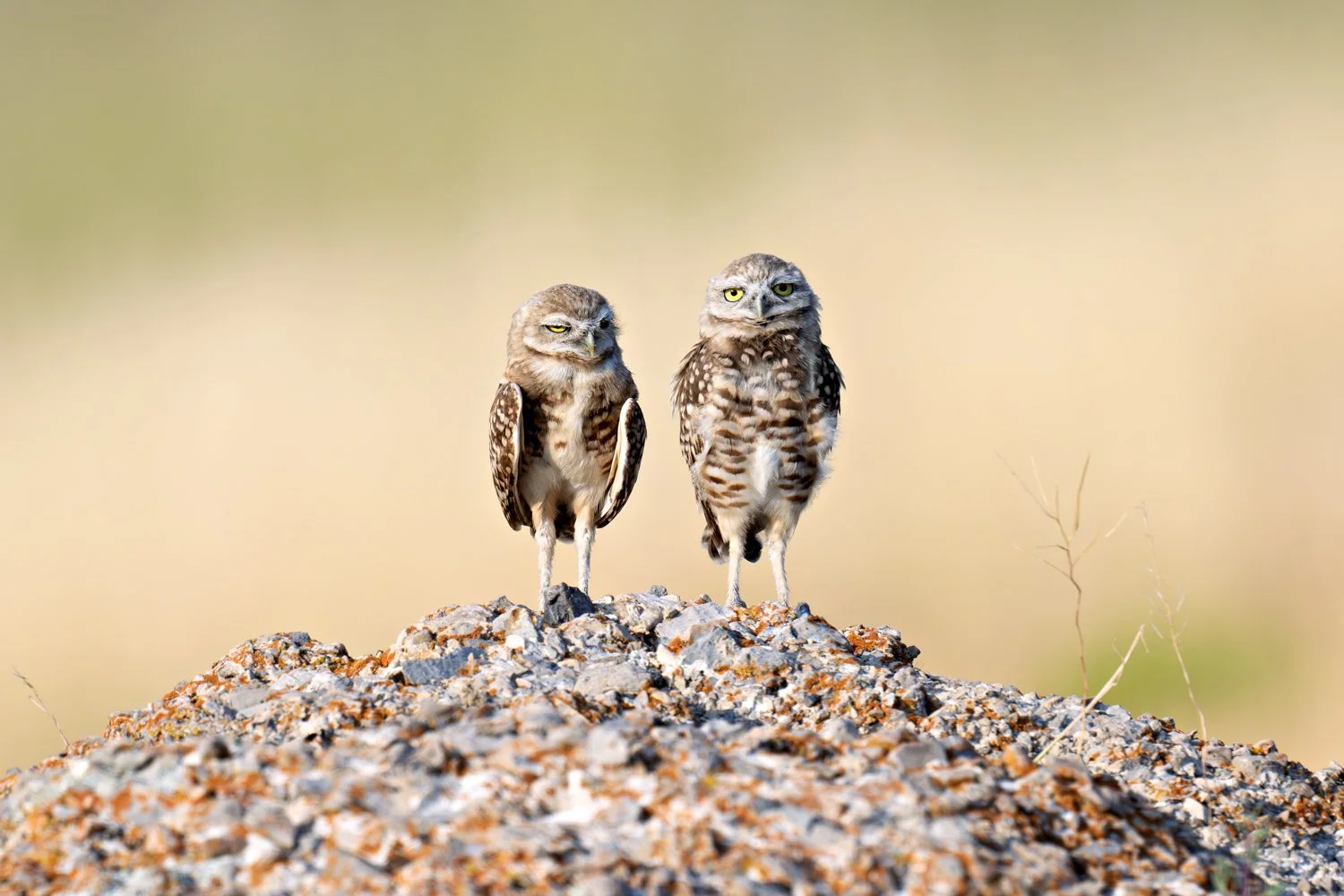
Photo by Mike Liechty
Mel and I are at the Salt Creek Marsh on a day in June. Above us, a raft of pelicans dance in the sky, their white feathers made gold in the afternoon light. We are here to check on the burrowing owl babies, fluff balls of feathers that shine in the sun. While Mel often remains in the car on these trips, she is the first to spot every single bird that comes to the marsh, often without binoculars. Even against the sun, she can name birds based on how they lift or land or hold their heads. She knows them from the inside. Not unlike the flammys who look for abandoned flicker cavities, burrowing owls prefer holes made by marmots. One of the few owls considered diurnal, they spend their days near their burrows eating grasshoppers and watching out for harriers.
Mel and Mike are the ones who first brought me to the Salt Creek Marsh, the ones who taught me how to see them. Now we go on Friday evenings to check on the families and watch the summer sun set. This year we named one of the owls Bob. He is easy to distinguish because he occupies a burrow next to the road. At the first of the season, I left Bob a bit of red string to decorate his burrow. The string is gone, either by wind or beak.
Weeks ago, a few days after she came to my yin yoga class where she is a regular, I asked Mel what she loves about birding. “They’re free,” she said, “and they fly.” She then told me about a pair of sand hill cranes that used to visit their backyard each year. One was lame, she recalled, and the bonded pair walked the field slowly, so slowly. “The one that was able would watch,” she said, “while the one that was limp fed.” As she told the story, I could hear the tears gathering beneath her words. The pair returned one season with a colt, and the colt was lame as well, the wound passed down genetically. Mel would sit at the window and watch the family feed. “No matter what happens,” Mel told me, “those birds can fly and be free.” This is what she finds so reassuring as she keeps track of the birds she sees from her window, the birds she sees on the marsh, the birds she sees from her car: “They are accepting of what happens to them.” When she gets to the part in her story where the colt does not return the following year, she is crying.
“I wouldn’t change a thing,” she tells me. “I wouldn’t change a thing.”
The sun goes down behind the mountains and bathes the marsh in maroon. All around us birds call, the marsh alive and frenzied. Mel sits in a chair and faces the setting sun. “Look,” she says, “two cranes and their colt.” Through our binoculars we watch them walk the reed line, the baby in between the parents, the sun turning the sky into a carnival of color. Soon the cranes will migrate south with the burrowing owls and the marsh will thicken with ice. Mel shares a line of a Rosemerry Wahtola Trommer poem: “Like a tree I grow / from the soil of all I’ve lost / I who did not die that day.” The cranes step onto an island in the marsh, where they will be safe for the night. We can no longer see them, but we know they are there.
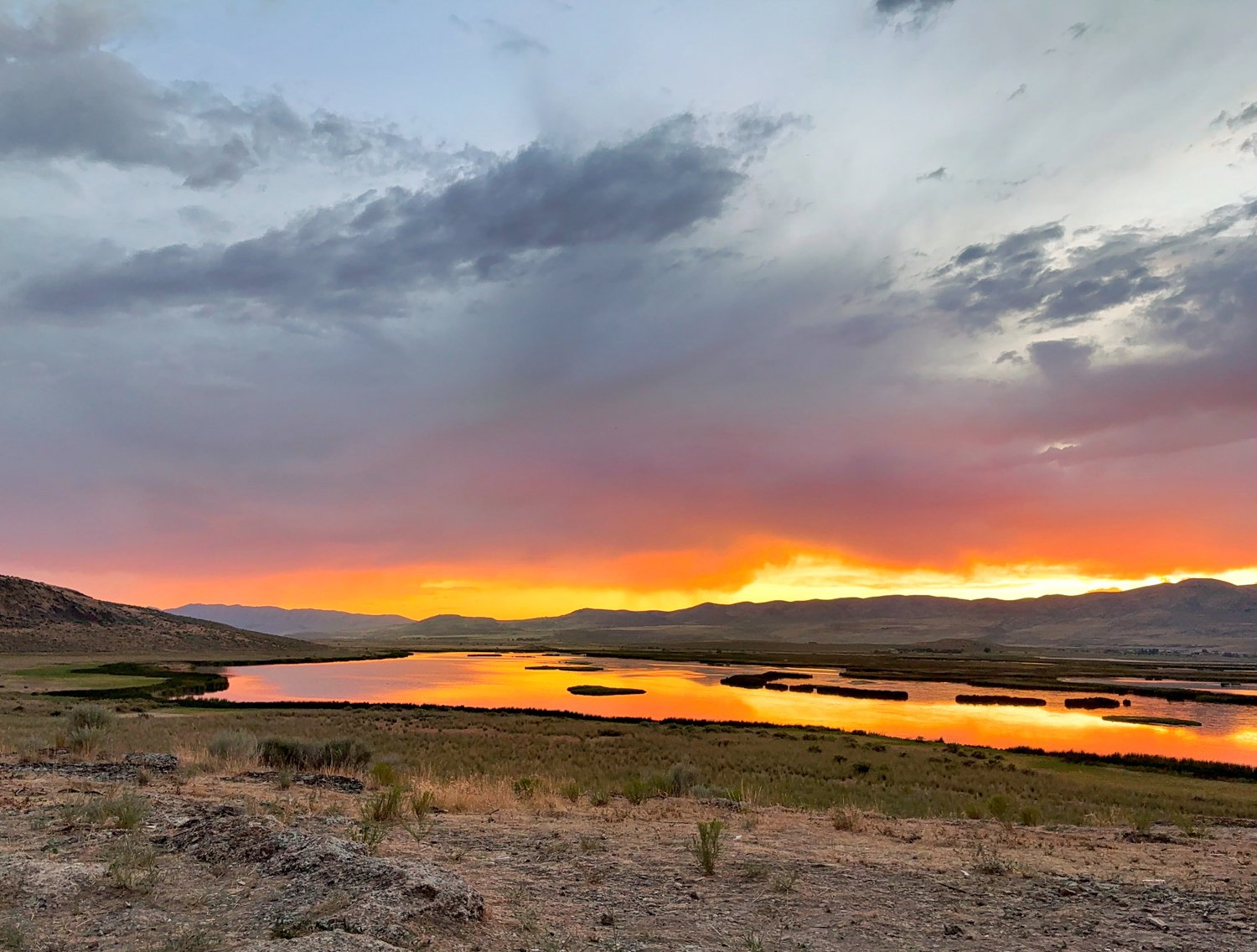
Photo by Mike Liechty