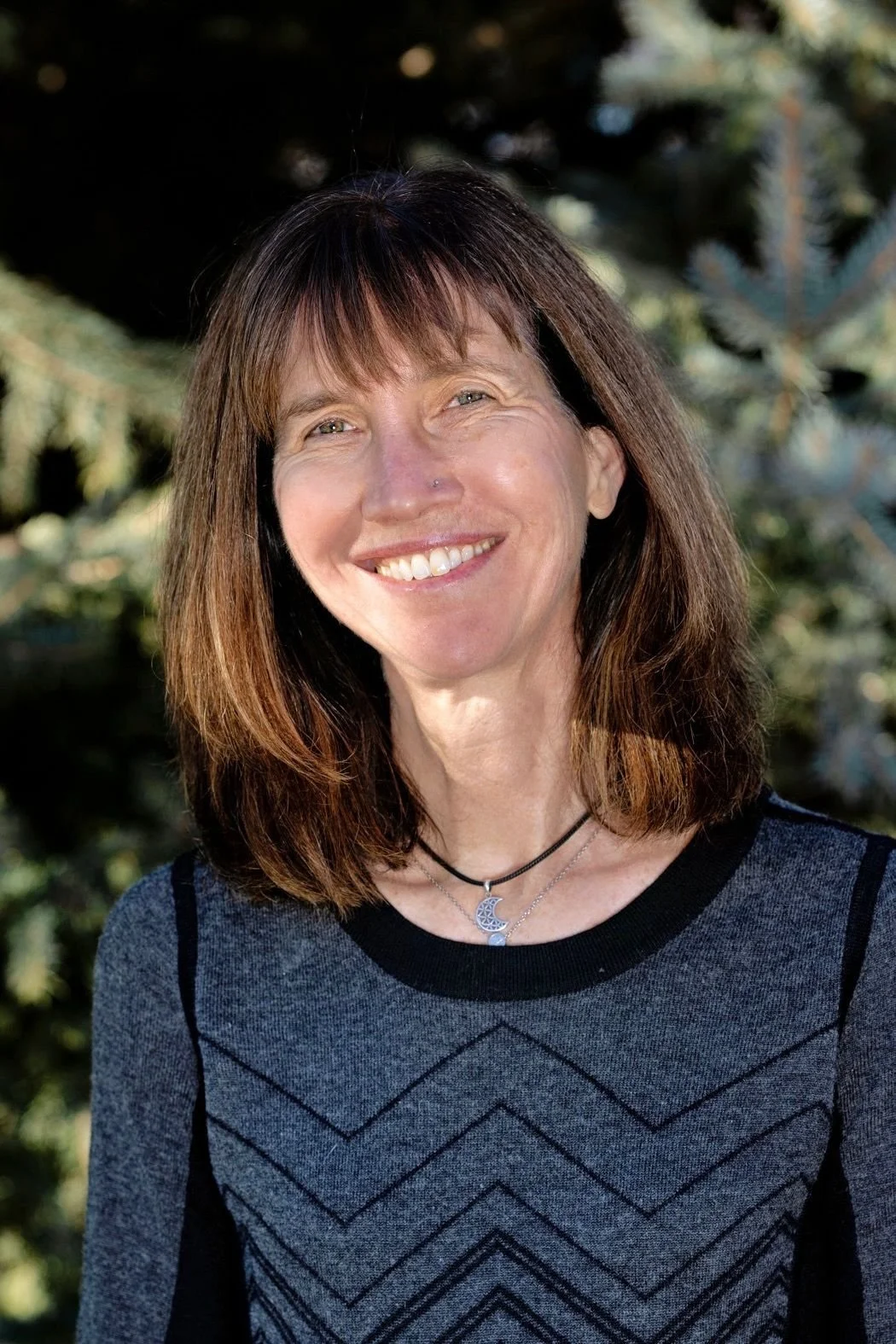
Jennifer Sinor on speculative nonfiction, bird-watching, and engagement with the natural world. <em>In conversation with Josepha Natzke on Sinor’s essay “Avimancy.” </em>
Read “Avimancy” here.
JOSEPHA
In your essay, you beautifully capture not only your own encounters observing (and searching!) for birds, but the experiences others have doing the same. I have in mind Mel’s story about the two cranes and their colt on the Salt Marsh. In the narratives it follows, your essay depicts bird-watching as a communal experience. Do you feel that your interactions with owls and other wildlife is inherently a shared experience, or is there a distinctly individual component to it as well?
JENNIFER
I can only speak for myself, but the best way for me to learn is through stories. When I am with others in the natural world, it is stories that we share—stories about what we see in front of us, stories about what we have witnessed in the past, stories about when we watched an eagle fish, or a rock slide begin, or a bear that stood on a ridge, golden in the falling light. I learn why aspens flutter because my husband tells me the story of their flat stems, or I learn to spot a burrowing owl because Mike shares the story of their shape. Landscapes are storied places, meaning what I see arrives narrated by what I see before me, what I have seen in the past, stories I have been told, and stories I tell, as well as the mystery and wonder of all that remains unknown (the holes in the stories). In that way, our vision is never singular and always communal. I don’t just see an owl—I see all I have been told of owls, all the owls I have seen, the ones I have read about, the owls of my dreams. Of course, in the moment I don’t parse it. I just know—honestly feel is a better verb here—that when I see an owl, I am not alone in that seeing even if I am alone in the woods.
I am a longtime yoga teacher and practitioner. If I were to frame this in terms of yoga philosophy, I would say that what we see with our eyes is incomplete. In Lorin Roche’s translation of the Vijnana Bhairava Tantra, he writes, “the heart sees by its own light.” To me this is how we should look at everything. When we look with the mind, we think we are alone, after all the job of the mind is largely to create the egoic self. When we look with the heart, we know that we have never been, and can never be, alone. The first way of looking leads to destruction; the second to grace.
JOSEPHA
I found the moment in the tour van when you as the narrator realize that you’re surrounded by dedicated birdwatchers super relatable—I’m a nature-lover who wants so badly to be out under the sky surrounded by the natural world, but I often struggle to identify or know the history of the wildlife around me. Did your experience looking for the flammys with the other birdwatchers motivate you to become a more “serious” birder? Was that a path you found yourself on already?
JENNIFER
I will never be even close to a serious birder, and I am okay with that. To be serious about birding or writing or dancing or cooking requires that we really dedicate ourselves to that which we are studying. In Patanjali’s Yoga Sutras, Patanjali writes that if our practice is to have a firm foundation then it must be uninterrupted, for a long duration, and done with devotion. His words are true for any serious practice we want to undertake. It is the ten thousand hours, the ten thousand pots, the ten thousand notes or lines or swings. Dedication to anything cannot happen through short cuts. It’s impossible. And we have one lifetime, so we have to decide just what we are going to dedicate ourselves to. For me, it is writing and teaching and yoga. I have given thousands and thousands of hours to all of these, and they are part of my practice every single day. Which means I let the rest go: I enjoy watching birds, but I will never be a birder. I enjoy rock climbing, but I will never be an alpinist. I enjoy knitting, but I will never cable stitch. And that’s totally okay with me because I am clear in knowing what I do want to dedicate myself to.
Maybe most important to Patanjali’s sutra is that he says our practice must be done with devotion—which means we surrender the results to something larger than ourselves. We commit the hours because we know that the art or the sport or the craft sustains us as individuals—not because we are trying to get somewhere but because devotion allows us to be entirely here, entirely present. Our ten thousand hours becomes an offering. We practice and we practice and we practice and we practice, all the time letting go.
JOSEPHA
In this essay you introduce us to Mel, who you spend time with birdwatching on the Salt Marsh, and you write her story of hardship, independence, and fierce love of nature. You mention photographs that provide distinct glimpses of her life, but can you tell us more about how you learned her story?
JENNIFER
This essay is part of a larger collection that I am writing focused on speculative nonfiction. I became interested in how writers are using the speculative in nonfiction maybe six or seven years ago. For me, the speculative is a space of hope in nonfiction writing because it opens portals on the page. I have been exploring the various ways the speculative can appear.
In general, a writer can move into the speculative in one of three ways. Traditionally, nonfiction writers would cue their entrance into the speculative by writing “maybe” or “perhaps” and then, once the portal was opened, have the freedom to move less tethered to “truth.” More recently, writers might make a speculative leap, often at the end of a piece, where a reader knows clearly that they have entered a new space. For example, Elissa Washuta makes that kind of leap in her essay “White City,” where she becomes the spirit power emerging from the undisclosed pond “with a body covered in death.” Or an author might begin in a speculative leap as I do at the start of my memoir Ordinary Trauma, where I tell the story of my birth—which I was present for but clearly cannot narrate. In both cases, the reader knows that the writer has entered the speculative, even though not formally cued. Finally, an entire piece might be speculative, like Melissa Grunow’s “Obstruction.” The “I” never appears in her short essay. On the surface, it is about a house, but we come to realize, late in the piece, that the essay is about the body, specifically the traumatized body. Another amazing example is Amy Benson’s “Lamarkian Evolution.”
In these essays, the writer is getting closer to the truth of what happened even if what they are writing about never happened. For me, that is the power of the speculative. We expand the space where truth dwells in nonfiction—and often that expansion is where we find liberation, change, and the power to transform. Hope.
In “Avimancy,” I wanted to explore the interiority of the characters who populate our nonfiction. A fiction writer has access to the interiority of any or all the characters they create, while in nonfiction the writer, traditionally, can only express their own interiority. But, as I say above in the first question, I think everything is much more connected than we believe. In the essay, I wanted to think about what kind of spaces are opened when I invite an interiority that is not mine. What happens when I cross the line between me and you and suggest that perhaps that line is more permeable than we might think.
I have known Mel for ten years, and I see her every week in yin yoga. For this essay, I formally interviewed her over three days. I transcribed those interviews and then informally coded them for themes. Based on those interviews, the pictures she shared, and my experiences with Mel, I wrote from “inside” Mel’s experience. I wanted the reader to wonder what right I had to Mel’s story because I wanted to think about how much more there is to the world, to our relationships to each other, than what we can see or know for sure. It’s a tricky line to travel. I tried to be careful not to hijack Mel’s story and make it my own. To that end, I asked her to read the final draft and provide feedback. In many ways, she is the writer here as much as I am.
JOSEPHA
In this essay, there are two distinct threads: one, your expedition with other birdwatchers to look for the flammys, and the other, a vivid narrative of Mel’s life which spans decades. Can you tell me more about your decision to keep those two narratives separate in this piece?
JENNIFER
Almost all of my writing is braided or woven. I am not sure I know how to tell a story any other way. It goes back to my belief that seeing or experiencing is always communal and in relation—that we stand at the center of all our experiences. I do not live one single narrative strand, and I do not want to write one either. My experience in my body is multiple and shifting. I want my writing to express that same sense of fluidity.
One of the most powerful braided structures, for me, is to braid three stands: a site visit, a research strand, and a personal strand. I learned this form twenty years ago from the brilliant Chris Cokinos. The personal strand carries the stakes of the essay, the research strand offers the metaphors that will transform the stakes, and the site visit gives the reader a through line to follow.
“Avimany” is not braided but woven, as there are only two strands. I can’t describe how I knew these two strands would speak to one another. I just did. It’s a bit goofy, but I really do believe that we write from our gut and need to learn to trust that. I tell my students that when we braid we trust that eventually the strands will come together. The strands came out of us; it is our work to pursue them on the page until they speak to one another. Together they accrete into something larger than they can ever create alone.
JOSEPHA
I’m so curious to know about your and Mel’s recurring trips to check on the burrowing owls. How did these trips begin? Do burrowing owls remain in this area once reaching adulthood, or do they eventually migrate based on the season?
JENNIFER
I love to go with Mel and Mike to the Salt Creek Marsh or the Bear River Migratory Bird Refuge. Both are about an hour from our home in Logan. They are the ones who know about birds. They are the ones who have given ten thousand hours to watching them. I am just grateful to be along for the ride. We are lucky to have burrowing owls live so close to us. Each spring the owls might take up new burrows or occupy old burrows but always in the same general area. In some climates, the males will overwinter to protect their burrows (they spend lots of time and energy “decorating” their burrows to attract a mate). We usually start to look for them in late spring, and they are often gone south by September.
JOSEPHA
A recurring theme is that you are shown birds by other people. Mel and her husband, Mike, are the ones who first showed you the burrowing owls. On the flammy tour, Tim uses a laser pointer to show the tour group where the owls sit in the darkness. In your essay, I keep coming back to this idea of intertwined birdwatching and community; that others’ knowledge often guides us better than our own. Did birdwatching initially draw you into communal experiences, or was it the other way around? What is the experience of spending time in nature with others who all bring their own background and interests?
JENNIFER
I want to return to my response to your first question: that my experience in the natural world is always communal even when I am alone. All true. But I do have a special love for birds even if I am not a very good birder. Alchemists described their coded communication to one another as the language of birds. They knew that birds communicated to one another, but they also understood that they were forever outside that conversation. Alchemists passed down their secrets in the same way—communication but only to those on the inside, a series of arcana. Birds, to me, remain secret keepers—entire conversations outside my door that feel familiar and inscrutable. Alchemists, as well as many ancient mystics, devoted themselves to birds because they, alone, could move between the earth and the heavens. Avimancy is the practice of predicting the future by watching birds. And while I don’t think birds can tell my fortune, when a hawk crosses my path during my morning run I attend. We can live in a world that seems mute or we can live in a world that is constantly communicating presence. I prefer to dwell in the second.
JOSEPHA
You are also a yoga instructor. In your essay, you trace Mel’s story, from the physical and emotional damage she experienced in childhood, through her MS diagnosis, and then into this post-diagnosis stage where alternative medicine helped her regain physical ability. Do you see ties between the health of our human bodies and our relationship to the natural world? Since you’ve written this essay, I suspect your answer is yes—but I would love to know more about how you see the two as related.
JENNIFER
Somewhere around the tenth or eleventh century, yoga underwent a powerful, if gradual, shift, because of the influence of tantra. For centuries, yoga had conceived of the world in dualistic terms, matter and spirit being eternally separate. Tantra brought in an understanding that matter and spirit are both sacred, that nature, this universe is a manifestation of spirit. The physical body, and the physical world, became divinized. After this transformation, ritual and sacrifice moved into the body. In essence, your practice became an effort to realize your own divinity or oneness. The divine was not in the sky; it was in your bones. Modern western postural practice is directly tied to the tantric turn: the poses we take when we practice are meant to keep us inside our bodies, inside the present moment, which is the only moment in which we can realize our true nature.
And that true nature is the same true nature that lives inside a tree reaching for the sun, or a wave crashing against the shore, or a rock that sits on a mountain ledge, not moving, for hundreds of years. That true nature is in everything. Call it energy. Call it light. Call it god. Call it space. It’s all the same thing. When we look at the sky, or the clouds, or an owl, we see ourselves. To practice yoga means to find yourself reflected in everything—not just the good but the bad as well. Nothing is banished. Nothing is outside. So, there is actually no difference between our body and the earth’s. It is in thinking there is a difference that destruction happens.
JOSEPHA
Throughout its intertwined narratives, this essay is beautifully lyric and brings words together to create new possibilities. Specifically, I’m thinking of the flammys as “two witches” perched up in the pine trees, and of the invocation you wish upon the reader when considering Lindsey Mack’s quote about witches: “You are Owl.” As a literary magazine, Punk Eek is really interested in this idea that change, specifically as it relates to our natural world, is needed—and that words can do a lot to affect that change. As a writer and a teacher, what words and ideas come to mind that have affected change in the way that you perceive and interact with the natural world?
JENNIFER
I guess I would say we need to welcome mystery back into our way of making meaning. Too often, we want to categorize and regulate and monitor—not just about the present but about the future—whole fields dedicated to knowing what will happen ten years from now. When we “know,” we think we have something. We get lazy or apathetic in our belief in having nailed down the facts of the world. But the more we know should really open us to all we don’t know. It has been said by many—even given a theoretical name—but I will quote Swami Dayananda Saraswati who says, “Take any one thing. What you don’t know about it is always larger than what you know.”
Logically, we agree. But we don’t live it, practice it. We don’t like being in the void—that space of darkness, where nothing exists, including language and light. We want the flashlight. However, as Wendell Berry tells us, “To know the dark, go dark.” When we do, when we travel into that mystery, that emptiness, that space of not knowing, the inchoate, the shapeless, and the unnarrated, we find that, paradoxically, all possibility exists. Most of us want the light of knowledge. But I want to sit with the owl witches in the dark. For, Berry assures, the dark “blooms and sings.” It is “traveled by dark feet and dark wings.”