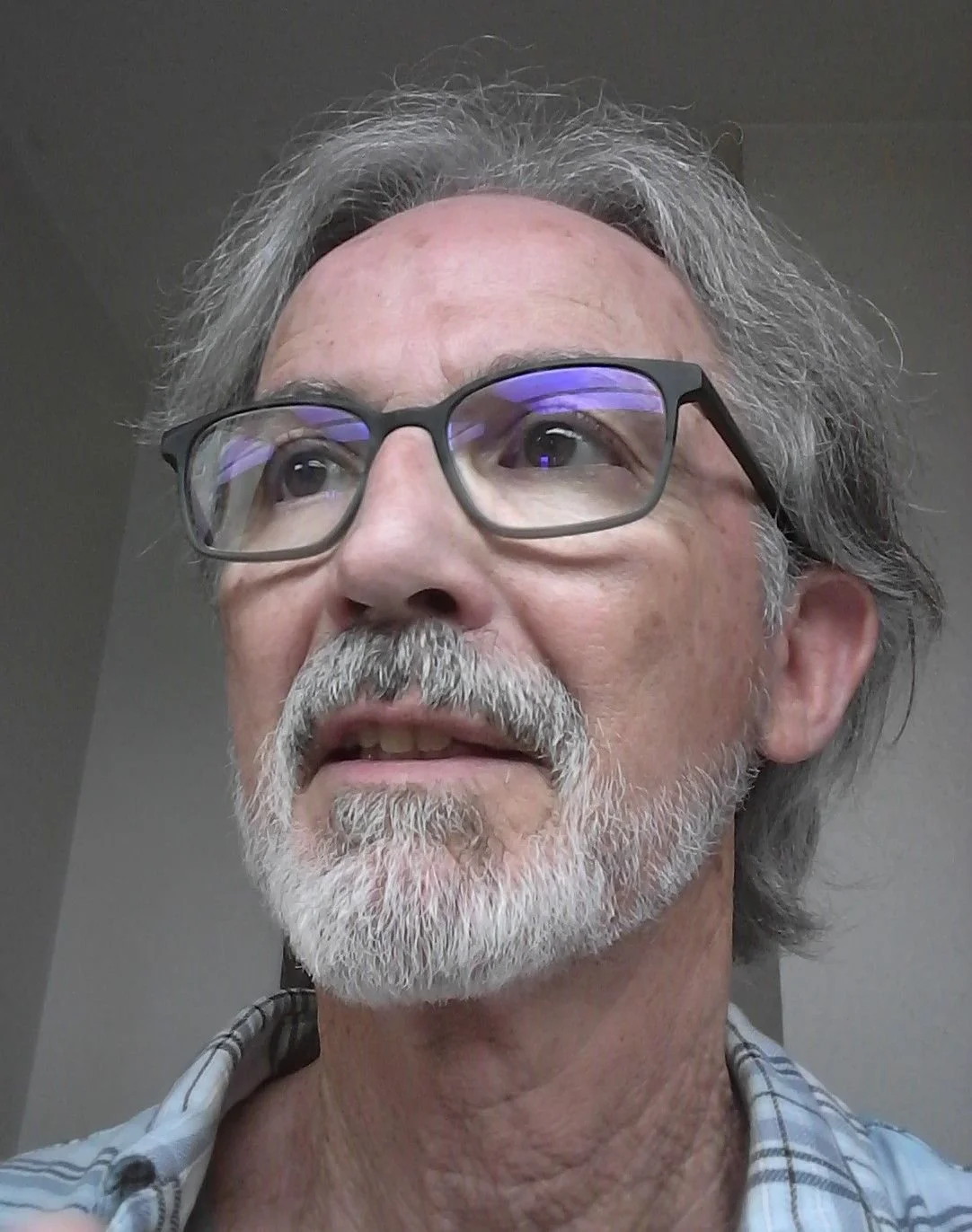
Richard Downing on Denial, Dark Humor, and the End of the World. <em> Richard Downing in conversation with Sara Byrnes</em>
Read “Weather—Or Not” here.
Sara Byrnes
I found this story incredibly cinematic. We move with Javier through this world, and the tension never really lets up. It feels like one snapshot of a potential climate future that is terrifyingly close. How did the idea for the story first develop? Was it sparked by an image, a news headline, something you witnessed, or something else entirely?
Richard Downing
I like your word choice: “cinematic.” I’m a very visual writer, and with “Weather—or Not” I felt as if I were filming the story rather than writing it.
How did the story develop? I grew up in Florida, first near the Gulf of America Mexico and later right on the Gulf. I have directly experienced several hurricanes and once had to evacuate my house by walking through four feet of water (aka, my living room) with my dog swimming beside me. Oh, yes, climate change is real and an impetus for the story.
Also, I am disturbed by the news personalities and deep-pocketed politicians who for years have vociferously mocked climate change’s very existence. All of this helped lead to the story’s creation.
But the immediate spark came from the people who won’t allow themselves to know that climate change is real, the people who try so hard to go on with their daily routines while rationalizing or turning blind eyes to the wildfires, hurricanes, and floods that inundate the daily news. This is Javier.
Sara
What I love about Javier’s character is how he refuses to surrender the world he knew. Even as he walks through the end of the world, he thinks of job interviews, the paint job on his car, and shopping. Could you speak on what drew you to Javier as the person through whom to experience this world?
Richard
I’m not breaking any new ground when I say that denial of change is a human trait. Leaving one’s comfort zone is uncomfortable—but for some it’s unthinkable. This is also Javier. Even though his denial can only worsen the situation, he cannot not deny.
He’s not stupid, he’s human.
Sara
Javier's perspective is so specific: The reader experiences this increasingly surreal and horrifying world through someone who remains preoccupied with the mundane. How did you develop his voice and decide what he would notice and, perhaps more importantly, what he wouldn't?
Richard
I gravitate toward characters who I feel are very different from me. However, if my creative process is actually processing, I gradually enter that character’s being to some degree.
In the first draft of “Weather,” I began to experience both Javier’s fear and his denial of that fear. I found myself starting to go on the walk with him—or more accurately, as him. It’s a form of contradiction, I suppose: If I can arrive at the point where I’m inside the character while simultaneously remaining a detached observer, then the story clicks for me and the details are just lying there, ready to be picked up and incorporated. This process reflects your word “cinematic”: I arrive at that point where I’m just filming what I see in front of me.
Sara
What do you think is happening psychologically for Javier when he continues looking for a job and watching the news as the world around him crumbles?
Richard
For the most part Javier remains in denial. He has little choice but to recognize that there is a problem, but in his mind it’s transient. In the last line he decides he will simply “wait until things get back to normal” so best to just keep doing what he’s been doing until then. But there are the briefest moments when fear-based reality unmasks itself, such as when he sees a downed power line and considers grabbing it: “Zzzzzzt—and it all goes away.”
Sara
The balance between the horror of this world and the absurdity of Javier's perspective made me laugh out loud multiple times—although I tend to have a darker sense of humor. Was that tension between horror and humor something you were consciously working toward? Do you often use humor to expose inconsistencies in human character or reality?
Richard
Yes, I’m very attracted to the tension between horror and humor. And I’m so glad you found the story to be humorous. I believe climate change is frightening, I believe Bernie Sanders when he tells me it’s an existential crisis, yet I had a most enjoyable time laughing as I walked along with Javier—although I don’t believe I was laughing with him.
Sara
We talked briefly during the editorial process about Javier's inability to accept what has happened to his world. His denial feels painfully recognizable: accepting reality would also mean confronting the fear and existential dread that comes with it. How do you personally navigate that tension between knowing what is happening and continuing to live an ordinary life?
Richard
I won’t lie: there is a part of me (small, I hope) that would like to bury my head into grocery shopping, cutting the lawn, reading, and walking the dog. But a greater part of me copes by first acknowledging fully that climate change is real, that our president is real (bite my tongue, bite my tongue), that AI exists and the jet stream soon won’t—OK, deep breath, we’ll stop right there. And then I try to act:
I vote of course. I co-founded a peace group and an environmental group. My students’ research papers must address some side of an environmental topic. I’m not delusional. I don’t think my actions will save the world. But I know a few parcels of Florida wetlands that have been saved, and a few of my students have had lightbulbs (LEDs!) turned on that I think will stay lit.
Sara
Is writing about climate catastrophe a form of environmental engagement for you? Do you think fiction can do something about climate anxiety that nonfiction or journalism can't?
Richard
Yes, for me writing about climate catastrophe is definitely a form of engagement. Will it change anybody’s mind? I have no idea, but I do know that it’s something I have to do.
Regarding the second question, I am a fiction writer, so I’m inclined to side with fiction as the strongest force. But having said that, there is so much excellent, persuasive nonfiction and journalism on the subject that my default answer must be: we need it all (see Punk Eek’s Into the Fire book reviews). Plus, the lines between fiction and creative nonfiction—and autofiction for that matter—have become so blurred—a good thing, I think—that I’m comfortable championing (as best I can) all of it.
Sara
You’re quite a prolific writer. Could you talk generally about your process? Are you the kind of writer who shows up every day to the page? What sort of writing ritual do you follow?
Richard
I’m not Stephen King; I don’t get up early and write a novel before my two eggs and pancakes. That would not work for me. I can go for long periods of time without creating anything new.
Take backs: during the fallow periods I rewrite what I once considered final drafts. And then I rewrite my rewrites. And so on. Maybe I’m kidding myself, but I’ve come to think of my rewrites as creating anew. When I am working on a first draft, my complete focus is on those characters.
Regarding my process, I’ll start with a mundane image or the scrap of a line that for whatever reason sticks with me (yet often doesn’t make the final cut). Then I’ll begin examining that image or extending that line on paper to see where it goes. I never outline. I have no preconceived idea where any of it is going, at least not at first. The not knowing used to drive me crazy, but now I enjoy the exploration.
And I want the piece to be funny—very dark and very funny.
Sara
I believe existential dread comes for all of us eventually, and that the void can also be a generative place. I feel most in contact with it when I'm outside in nature. Is there a place you return to that stirs something similar in you?
Richard
Oh, Sara, what a good question on which to end. Nature, nature, nature. Get it while you can.
*** Public Service Announcement***
Everyone, buy a copy of John Fowles’ The Tree, the version with Frank Horvat’s photography.
I’ll wait. . . . Now read it. Better yet, experience it.
*** End of PSA***
I grew up in Old Florida. You could swim in the lakes without dying. Eat the fish you caught in them without dying. See the beach from Gulf Boulevard without having your vision blocked by another godforsaken high-rise. I’m not a nostalgic person and certainly not a nostalgic writer, but I must confess that I do return mentally and necessarily to the rainforests of Costa Rica. And I can sit outside for extended periods of time on my front porch, watching and listening to the mockingbirds in the large water oak.