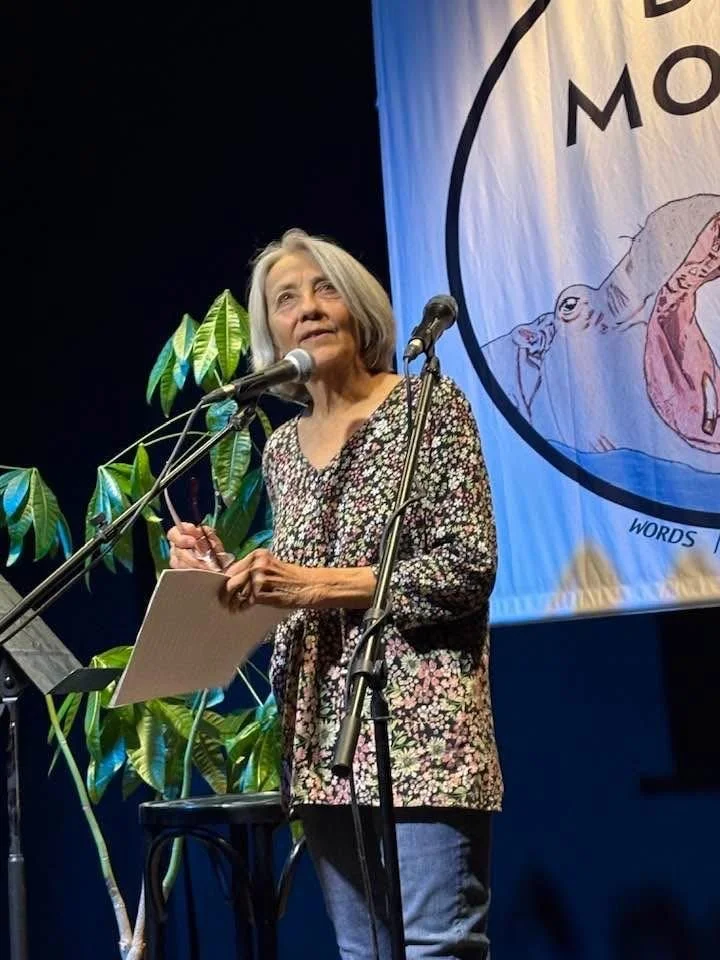
Tina Carlson on Craft, Mystery, Loss, Memory, Light, Nature, and Devotion <em> Nathan Conroy in conversation with Tina Carlson</em>
Read “Tethers and Eddies” here.
Nathan Conroy
One of the things I love about this essay is the seemingly disparate threads that you weave together—rafting, your relationship with your mother who’d passed, and the mysteries of quantum physics. But the scope is marvelous too. As we traverse this inner and outer landscape of grief, the reader goes on this journey along with you, from the inside of atoms to the life and habits of electrons and photons, zooming out to space and the continuity of lifeforms as shifting patterns of carbon bound by the beginning of time. But you also do this with the landscape, showing the billions of years stratification, and how calcium carbonate dissolves from limestone in springs considered sacred by the Hopi. With rock, nature, and even the narratives—the stories we’re telling now and the past, I wondered: is this scaling a conscious intention or regular practice? Given more space in this essay, is there another part you would like to scale that you didn’t?
Tina Carlson
This scaling was inspired mostly by the canyon—we were surrounded by and living within billions of years of the earth’s history and held it in our hands, slept on its sands and climbed up cliffs and gullies to explore it. The day we were able to hold the earth’s mantle in our hands was life changing for me. To be able to see the stars so clearly and think about their atoms inside our bodies filled me with awe. A person’s life has scale, as well and death brings that into focus. This past year has been a time of coming into greater awareness of how small I am, and how deeply connected to everything else.
Nathan
I love the way the title, “Tethers and Eddies” echoes the personal and natural forces that tie us together and spiral apart. At the beginning of the essay, you’re “tethered to possessions, missing and found, that reminded me of home, gear that felt essential to survival.” Though tethers connected us to our world, each other, and other essentials for survival, they could also hinder us and hold us back. “Eddies could snag a raft into circling for awhile.” “Those of us left behind, still circling in eddies, felt untethered for a while.” Between all the mysteries of physics, the focus on light, and the changing places and living circumstances of home, how did you land on these as the title/theme?
Tina
Great question! Eddies were so fascinating as natural features of the river where spirals and circles were made, and the concept of tether felt both practical and spiritual to me. Those words kept coming to me on the rafting trip—my friend Lynn and I kept wondering about the word eddy—its etymology and meanings, as we rafted down the river. And tether just kept arising in my mind. I love the sound of the words and the way they sound together. Maybe it was the river that whispered these words to me.
Nathan
I wanted to talk with you about mystery. Instead of running from it or using science as a know-it-all mystery-eraser, you lean into it. Not only does quantum mechanics say something can be other than what it appears, but any given reality depends on how it’s measured. How did you choose to hone-in on this ambiguity, this more complex gray area rather than some hard and fast static truth? Did the focus on mystery and a more complex truth—or array of potential truths—change the way you approached writing and reading/researching for this essay? Speaking of this reality depending on how it’s measured, I’m thinking about your essay and how it’s perceived. How do you write so it will be measured and understood the way you measure it, or is this an impossible ask?
Tina
The older I get, the more mysterious life is, really. I have always been someone more interested in the life of trees, what lives in dirt, or how stars are formed, than I have been in bank accounts and nice furniture (at times to my detriment, I am sure!). My mother’s death really affected me strongly and after she died, I dreamt she visited a few times. The dream I had about the canyon before I went, where nothing was solid, stayed with me on the trip. I studied molecular biology in college and found that world to be filled with mystery, invisible to the naked eye. And then there is the Grand Canyon. I was so impacted by that trip and the enormity and power of that place that I was unable to write about it. It really helped to take Jonathan Clark’s braided essay class to find a way in. I knew little about quantum mechanics and I had to really work hard to glean basic information for this essay. But Jonathan’s encouragement to do so was so helpful—using my brain to research created a platform and friction to help make ‘sense’ of the rafting trip down the Colorado. My mother’s death and history with her just jumped in spontaneously one day while I was writing. I don’t think about how my writing will be measured when I write, but rely heavily on others to tell me what lands and makes sense to them on reading it, to revise.
Nathan
One of the major themes of this piece is loss. With each instance we confront it head-on, but also from angles, examining its complexities and processes as you let go. With your mother, there was a long, arduous process, a prolonged goodbye. With the items on the Grand Canyon, the items you lost each day seem to have been swiped without warning. In parallel to the independence, book clubs, and church community your mother lost, you lose a random green sock, fleece mitt, and toothpaste. The river incrementally gives you more opportunities to practice the art of letting go on smaller objects. It made me think of the poem “One Art” by Elizabeth Bishop. In the poem, losses traverse from the mundane of door keys, places, and names, to the more expansive: rivers, cities, and some “you.” Some of these losses are easily identifiable and containable whereas others, no matter how long we observe them, seem to continue expanding or shifting, like measuring photons. Because of your keen observations, were there other poems or thinkers on this topic that helped you as you concocted and thought about your process and this theme? Did you begin to compile a categorical understanding of losses, arranging them by some metric, whether how entangled they were, how replaceable, how unique?
Tina
I love that you invoke Bishop here! There are so many books about loss that inspire me! Living poets and other writers I read and have been recently inspired by, related to loss: Ocean Vuong, Sunni Brown Wilkinson, Rebecca Aronson, Jenny George, Victoria Chang, Jericho Brown, Cristina Rivera Garza and Jake Skeets. But isn’t life the best teacher? It is impossible to live without loss and although there are many ways to distract ourselves from the impact of that. Ultimately, we must face our own mortality and that of those we love. I didn’t compile a list really, the losses flooded into my mind randomly in the writing process, as losses tend to do.
Nathan
We stay with mysteries—the mysteries of quantum physics, the mysteries of the nature and history of the river, and the mysteries of how our relationships exist before and after the starts and ends we see. But early on in the essay, you mention what stayed with you are the ghost sightings in slot canyons and in stories read to you by guides before bed. These, however, didn’t make it into the essay except as a mention. What made you choose to omit these besides this reference? As a fan of some stories with ghosts (May-Lee Chai, Jason Mott, Fyodor Dostoevsky, Ambrose Bierce, et al), I liked this nod to the mystery and the picture it painted of the places in the caves and beaches of the canyon where, over the years, ghosts and their stories were passed down. With all this essay holds, it’s too much to roll back into the story with the bandwidth and focus of it, but—but!—I also wanted a hint or taste of the ghost stories. Is there something you can share from this—both from the stories or places they were told and why you both included and didn’t include them?
Tina
I didn’t include more about the ghost stories because the actual story and how it was told in the dark by one of the wonderful guides is almost another essay! There were so many magical moments on that trip and taking a silent hike inside a slot canyon was a highlight, where one guide strummed her banjo and sang beautiful songs as we quietly walked to the end and then came back to the center of the little canyon and sat or lay on stone, listening to her and the swallows who nested in there. What an intimate space, where, without talking we were more connected than ever. After that hike, one guide mentioned there was a story of a ghost encounter in there, which was totally believable after being in that sacred space—and one night at bedtime another guide read us the story from a book of stories written by river guides in the canyon, one of a number of books in a small library we were provided, kept dry in a metal case.
Nathan
Navigating the chasms of your relationship and loss via the Grand Canyon, I thought the canyon would have some lessons presented in a grandiose fashion, especially with the warning that you’d nearly drowned on a rafting trip prior to this, but in this essay, the most mirrored examples of loss are a summation of persistent but comparatively micro losses of items, almost arbitrary in selection: a green sock goes missing, a fleece mitt, and toothpaste. In missing, the green sock stands out even more. In one passage you speak about how your mother is now “a breeze, a bird, a threshold of slot canyons that empty into the river’s heart. A rift in her lived-in rooms.” These missing objects and your mother, they live on and are saved in our memories. I think of Cicero and his Memory Palace. When he was dining with a group and the building collapsed, he remembered who was sitting where speaking to whom, and therefore, who was still unaccounted for and where, showing the spatial orientation of memories. Memories can live on in the relational spaces where they were formed and where they are revisited. Can you picture still where you were for the sock and mitt and toothpaste? More interestingly still, with writing, we bring these pieces of nature, ourselves and those close to us to our writing desks, schools, beaches, benches, and cafés where we write, as if planting outposts of our memories there, too. I’m curious about this act of revisiting, namely, how it affects the way we perceive who and what’s lost, how it keeps them close and brings them to new places. I guess my question is what do we gain by revisiting our losses, and how can we revisit them in places that foster a healthy evolution of remembering?
Tina
I do think we can gain from revisiting, particularly if we are not reliving and rehashing old harms and bitterness. There was a time in my life when I did this in relationship to my mother and that was very unhelpful to my own growth and other relationships. I like what you call a healthy evolution of remembering. Being in the canyon, gazing at the night sky, or finding some larger place in our hearts or lives to remember, or remember from, fosters that more expansive sense of memory, where mystery resides, and surprise. What I can say today, is that working on this essay has really helped me revisit the magic of the canyon as well as the poignancy of coming to a place of calm and tenderness towards my mother.
Nathan
One aspect of your story that stays with me is how the role of light keeps changing, and how light in the story acts as a character or narrator. Light plays on the canyon’s waters and stones, moonlight paints graffiti, and light makes arcs across space as stars. Light is also shined on history, history your mother wanted to forget. In this sense, it’s a revelation of a truth, even if that truth is frozen in time and/or continues to develop. Light is also a speed (as it has its own speed), and a marker of time and distance (light years). The interesting note about this last understanding of time and speed and distance is that quantum entanglement appears to connect across these major gaps and differences. We spend so much time with light in this piece, and yet, you don’t stifle or overwhelm us with this, either. The light is a companion of the dark, and vice versa, and you treat us to both. Did you start with light seen in the canyon or light photons in physics? How did these two develop for you?
Tina
I started with light in the canyon, which is magnificent and subtle and captivating. Living outdoors without a phone or electricity for over two weeks really changed my relationship to light—it was a daily force that was direct and reflected and essential to our day. Studying quantum mechanics and refreshing my memory about photons created a deeper appreciation of the qualities of light on a molecular level. Then the two were able to play with each other in the writing of the essay.
Nathan
Your essay could have easily leaned into the hardships of rafting and being outdoors, and indeed, we begin there, with items going missing and the harsh conditions of heat, cold water, and sand swept nights. But by the end, the stars at night were the brightest you’d seen, the canyon’s reflected light and the colors of the water and stone, the behaviors of the animals—hooved, winged, finned, and amphibian—show a different relationship with the landscape. You wrote, “On the day before my birthday, I washed my hair in freezing water, standing on a stone. My old stories, pressed down by the spell of generations, dissolved in the liquid that keeps us alive.” I could keep quoting, but this scene of cleansing, and the questions it brought up in the piece, I felt there was more here that the essay and its scene couldn’t quite hold but could send representatives for. Part of grieving is a reclamation of who you were, who you want and wanted to be, with yourself and others. Sometimes our moments of cleansing are the dirtiest, and, when in water, we can see the residue rinsing in concentric circles from us. This is harder to see when what we’re rinsing isn’t the dirt of the earth, but emotional residue. This passage was powerful because you shared some of the invisible, intangible residue, and we can read it rinsing off, addressed, cleansed. How did you transmute the discomfort of the outdoors into a relationship not only of comfort, but of the medium of cleansing?
Tina
These questions are gorgeous, by the way. I didn’t transmute anything, the river did that work. The moment of washing my hair in the river was astonishing. I literally felt so much leave my body, including fear, but was not aware that stories, or the charge of old stories, also washed out. It was later in the trip when someone asked me about my mother and I felt a sense of calm about her life and death and our relationship that stunned me. Being her daughter created a well of emotional angst and anger and fierce love too, and all of that was softened by green water making an enormous canyon a little bit at a time.
Nathan
In this essay, nature is a healing force and the way you write about it, the animals, light, water, and stone come alive through lifespans that eclipse our human time on earth. I’m thinking of the “river of stars,” the “massive yawn in the earth,” the cream-colored flowers blooming in the sand, but even hints of the animals passing through (“prints of the thirsty” at a waterfall) and the remnants of those passed (the bighorn sheep). As a writer and editor (and someone who was “unimaginably calm while starting to drown” rafting the Chama River), what readings, ideas, and experiences have guided you to your understanding(s) with nature, to see its many faces?
Tina
I grew up nearly feral in a vacant lot in Colorado, in the years after the second world war. There were two other girls in that field, and we spent hours climbing cottonwoods, playing in the irrigation ditches, sucking on weeds and taking imaginary journeys into the sky or around the world. Those early experiences as wild girls are my muse as well as spending countless hours hiking and skiing in the Rocky Mountains with my father who spent his years as a soldier on skis in the Alps and was a true mountain man. I read a lot of eco-poetry and fiction and nonfiction about nature—recent favorite examples are ‘Is A River Alive?’ by Robert Macfarlane, and ‘Land’ by Maggie O’Farrell.
Nathan
You are quite a prolific writer, having published three full-length collections of poetry and a chapbook, as well as editing for Unbroken and Hot Flash Literary. What inspires you to the page and what rituals keep you grounded and devoted to the practice?
Tina
I belong to several writing groups and am active in the writing community in my city. These activities provide a lot of support (and deadlines!) for my writing. I try to sit down every day with writing in some form, either generating, reading and/or revising, to keep the momentum alive. I guess I could say writing is a tether to a deeper part of myself and also to the world.