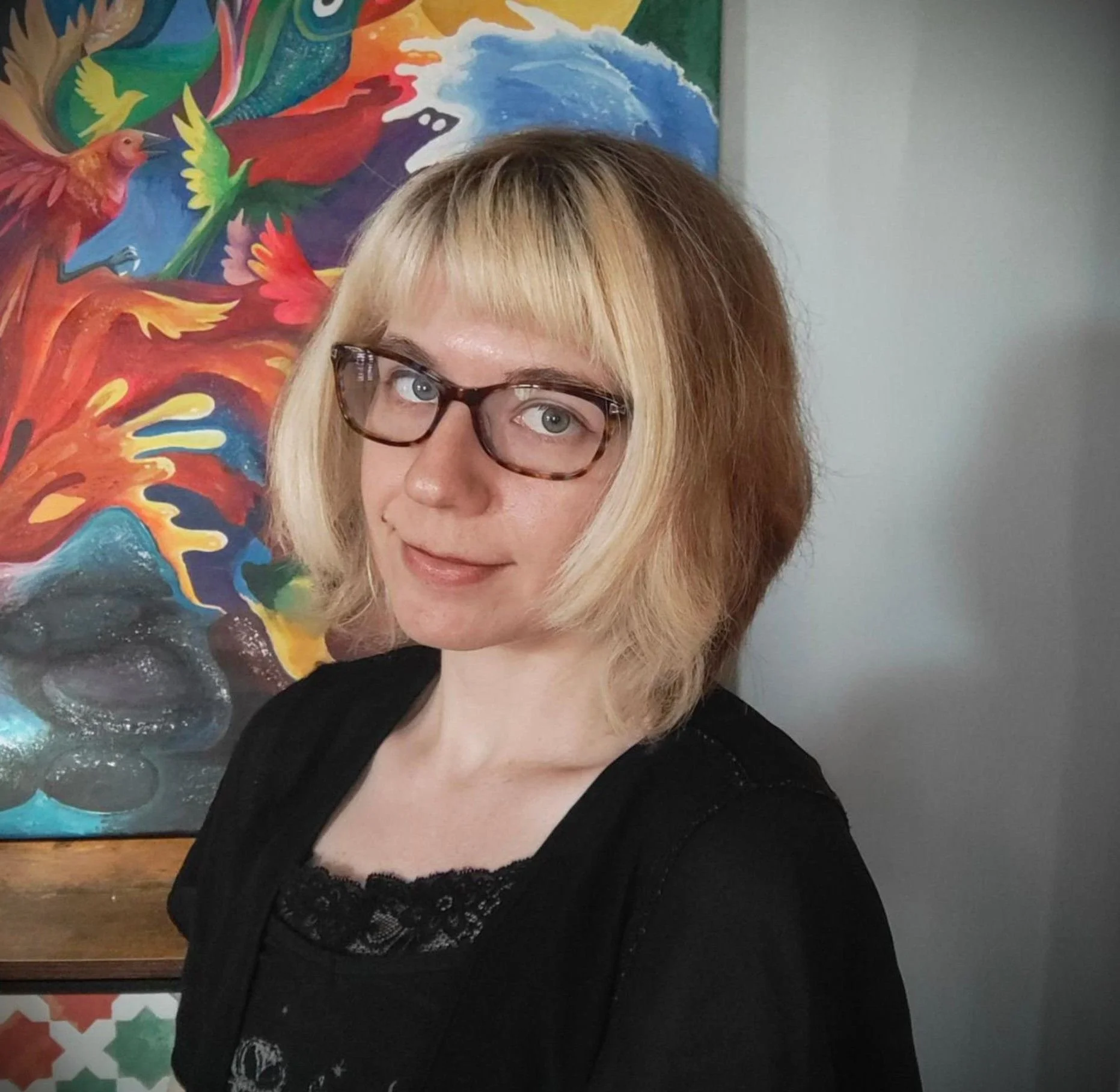
Kristin Emanuel on playfulness, evolution, and recognizing the marvelous. <em>Kristin Emanuel in conversation with poetry editor Camille Bliss</em>
Read poems here.
Camille Bliss
Your collection balances the shock of death, and the impossibility of birth and becoming—“you are fantastical and doomed.” Both exist, but where do you focus your attention? At what point do you remember to take a step back and remember the marvelous?
Kristin Emanuel
I try not to cleanly separate the shock of death from the impossibility of birth. The two can coexist in the same breath, just as the marvelous can encompass doom. It’s less a matter of dividing focus between the two, and more about entangled focus. Take, for instance, the Cambrian Explosion. During this period, a shockwave of animals speciated, many of which look quite alien to us: Opabinia, Anomalocaris, trilobites, etc. These species are long gone, yet the certainty of their extinction doesn’t lessen the dazzle of their existence. The same holds true for us. We recognize the marvelous when we are attuned to our own doom—and through that attunement, able to look beyond it. It is important for us to see ourselves as animals in the world, part of evolution’s ongoing fantasia.
Camille
You pay close attention to consonance in your poems. For example, in “gentling,” you write, “now your ears gulp music / your eyes gobble light,” and in “Everything is Ideological, and There is Also the Ocean,” there’s “with its spume and sea glass and sand-crusted shells.” Is your knack for a poem’s sound intuitive, or do you consciously shape these patterns during revision? How do you choose certain words over others based on their texture?
Kristin
Like many aspects of craft, sound started as a conscious decision and then became more intuitive over time. Poetry is a synesthetic landscape. You have onomatopoeias and autological words that create sensory information, orchestrating connections between the cerebral act of writing and the natural world. “Spume” has a slimy feeling when you say it out loud that mimics the texture of actual spume. The word “shell” makes you curl your tongue inwards, mimicking the morphology of a real shell. A good eco-poem marries text with texture. We carry landscapes in our bodies and in our language, and we must tend to them.
Camille
I’m often inspired on long phone-less walks in the woods. What spurs your creativity? Do you have a ritual that ignites your process? Why do you believe these moments are important not just in writing, but in our lives?
Kristin
In a world of constant preoccupation and convenience, poems are profoundly inconvenient. I think that’s what I like most about them. They ask something from you that much of the world doesn’t: to sit with the facts of life instead of escaping from them. My most creative moments are in transit or while waiting. These in-between times invite thoughts that I would normally shoo away. I believe we are more honest with ourselves when we are twiddling our thumbs.
Camille
Sometimes I look down at my feet and am baffled by their existence. I’m reminded, while reading your collection, of the miracle of our bodies—their impossibleness. How do you think about evolution? For you, where does the magic of existence outshine its predictability?
Kristin
I am often baffled by the back of my head. It’s odd, miraculous, and a tad undignified to remember that we walk through the world with a frontal orientation. It’s odder still to remember that we exhibit bilateral symmetry instead of, say, the radial symmetry of flowers. Holding onto this absurdity is an important part of my artistic practice.
I don’t think there is anything especially predictable about life. Certainly there are patterns and medleys, variations on eyes, forelimbs, and wings—but those variations still offer surprise. Scallops can have up to 200 tiny bright blue eyes. A spider in Peru builds a mysterious structure called “silkhenge.” The Satin Bowerbird collects blue objects to woo potential mates. He gathers organic matter like plucked butterfly wings and flowers, but also straws and bottle caps, missing jewelry and lost house keys.
Richard O. Prum describes these behaviors in his book The Evolution of Beauty. While I’m no evolutionary biologist, I’ve come to realize that nature is not as ruthless as I learned in grade school. Survival of the fittest is just one aspect of a multi-dimensional history, splatter-painted with randomness and frippery and courtship rituals. Now here we are in the twenty-first century, billions of years after abiogenesis; somewhere, a musician is crooning a pop song about love, while somewhere else, a bowerbird is rifling through a dumpster in search of a blue plastic spoon. That’s not predictable. That’s downright magical.
Camille
We’re constantly confronted with the effects of climate change—from “newsflashes & flashfloods & earthquakes” to the changes we witness in our own communities. In “Excerpt from The Loch Ness Monster is a Widowed Time Traveler,” there’s a desire for something hopeful, yet out of reach. Do you believe a healthy planet is an impossibility? What role can hope play in sparking change?
Kristin
Poets have a duty towards language, and by extension, towards the collective imagination of our species. That is why I am an advocate for eco-hope in lieu of eco-grief. Grief is cramped, but hope has room. It invites us in. It’s a perspective that we can grow to fill. I’m no soothsayer, but I know this to be true: our attitudes and habits of mind shape reality.
Camille
Sometimes I need to set a project aside because a memory I’m working with is still emotionally charged. You alchemized a fretful memory of your father teaching you to drive in “Belief System,” into something so poignant. How can distance from a haunting memory reveal a new understanding of the past, and how can this distance assist in the writing process?
Kristin
In my poems, recollections are part of a philosophical narrative that I have been rehearsing about my life–one that I am constantly testing. Unlike memoir, poetry allows you to splice memories into vivid, manageable pieces and embroider them with dreams. You don’t have to place a memory within linear time in order to process it. Sometimes you can approach memories upside down or backwards. You can reimagine your memories refracted in a hall of mirrors, or as beads in a kaleidoscope.
“Belief System” is a good example of this. My decision to begin driving later in life meant that I wasn’t following the typical social script of a high schooler, giddily clamoring for independence. Instead, I was a late-20-something facing my greatest fear. Driving and death are interlinked for me. It’s hard to ignore the roadkill scattered along I-70, and I have other viscerally haunting memories, too, like a dead dog lodged in the grille shutter of my father’s car—the same car that I now pilot through the world. My getting behind the wheel was an acceptance of danger and of my own horrific power to harm, but what set this decision into motion was something altogether more tender and lifegiving. I wanted to be dependable for my loved ones.
I was able to write “Belief System” only after accompanying a dear friend to the ER and driving my dying songbird to the vet for treatment. For this poem to take shape, I needed to test my fledgling philosophy (that the car could be a conduit for care) and discover it was true. While I wish it weren't the case in America, our death machines double as life preservers. We are emitting CO2 even as we are commuting to doctors’ appointments. My ability to hold these two competing realities together has made me sturdier for the humans and animals in my life. In “Belief System,” I explore how precarious this belief system really is; it is constructed from neural pathways full of heightened love and inevitable harm, where I can hurtle backwards from death into realness.
To touch on the general question again: there is no simple trick to writing memory, beyond that for me, it comes from a philosophical place, a place of deep intention that emerges only after I have tested my assumptions about the world and found that, when translated into poetic form, they can finally bear my weight.
Camille
While I am childless, I’ve had an affinity for children’s books. What I love about your poems is that they etch these enchanting visions in my brain; you’ve illustrated a children’s book with words. Especially in “Belief System” with a grandmother, sabretooth tiger, and three mice roasting marshmallows around a fire. Your poems burst with whimsical imagery. How does this playfulness help you approach subjects such as grief in your writing? How about Mortality?
Kristin
Playfulness is one of my core values. In a pragmatic sense, play is how we calibrate ourselves as children. We see it in other animals, too: a kitten learning to pounce on imaginary prey, or wolf pups wrestling to figure out social dynamics. Young animals must practice for survival, rehearsing skills and hierarchies.
At some point in adolescence, we reach a developmental threshold where we transition from playing to living. Pretending no longer feels as permissible or as effortless as it once did. As adults, we can sublimate our desire to play into art. One of my most profound experiences in the classroom was when I taught Fluxus and the Happenings. These neo-avant-garde movements from the 50s and 60s are a major focus of my dissertation. They involve a group of painters, poets, and musicians who penned and performed silly events. You have John Cage’s Water Walk, George Brecht’s Drip Music, Hannah Weiner’s Signal Flag Poems, Yoko Ono’s Mend Piece. I could go on.
In his essay “Just Doing,” Allan Kaprow claims that play exists at the heart of experimental art, and that “playing with everyday life often is just paying attention to what is conventionally hidden.” When I challenged my students to write and perform their own events, they were suddenly tying their shoelaces in front of the classroom, whispering secrets to jewelry, clapping, stepping on paintings, and crumpling pieces of paper. It felt anarchic and joyful, like we were making the world anew.
As a teenager, there’s a push for you to disown childishness so you can prove your commitment to the real world, yet as an adult, I’ve found the opposite to be true. Holding onto childlike play makes us more capable, more attentive. Play is gleeful. Play is also humble and intellectually honest. When we play, we admit that there is something we don’t know. Something that we must practice. This is where the more serious aspect of your question comes in.
In my poems, I try to address heavier topics with whimsy: critically endangered rhinos are abducted by aliens; dinosaurs perform courtship rituals; the Loch Ness Monster is a widowed time traveler from the Mesozoic era. Storybooks, fables, bedtime stories—these are didactic modes of writing, imparting life lessons through animals. I adopt a similar attitude in my work, which is why I use the label eco-fabulism. The difference between eco-fabulist poetry and children’s storybooks is that my writing leans more heavily into unresolved matters. As adults, we are not learning easy, actionable lessons through play or developing basic motor skills; rather, we are practicing for the difficult lives that we are already living. I am practicing for ecological loss, for personal grief, and for my own death. I am working on my emotional vocabulary for the future; I am pretending myself into existence.
Camille
Even when life feels overwhelming, I believe it’s essential to be grateful for what we have. Your poems find wonder in the natural world, and its little magic moments. How do you focus on these pockets of joy in the natural world in the whirlwind of so much uncertainty, and has this practice of noticing wonder shaped your daily life as well?
Kristin
There’s an irreconcilable tension that I hold in my poems and in my worldview. It has to do with scale and responsibility. Writing about environmental catastrophe poses a unique challenge, because it is huge beyond fathoming. Change relies on collective action, collective bodies—so what can I accomplish in my singular body? Confronting this tension makes me feel uncertain, like you mentioned, and excruciatingly small. But when I think about smallness, I also think about an old zebra finch I fostered named Johnny Kazoo, only the size of a teaspoon, who built nests out of rainbow confetti. I think about Klaus Kemp’s diatom artwork made from single-cellular organisms arranged under a microscope. I think about how scientists recently discovered a sugar molecule in space.
When we are small, we are in good company, open to wonder and joy. I have a longstanding commitment to wonder, and I try to carry it with me wherever I go; it’s my ultimate rebellion. There are a lot of forces (corporate, political, etc.) that gleefully quash wonderment, wanting nothing more than for us to focus our attention on vapid desires and hollow angers—but these forces, as big as they might seem, are in a philosophical sense, smaller and far less interesting than a sugar molecule in space.